Friday, March 25, 2022

Book Review: Whispers of Stone by Allegra Pescatore

                         A white man with dark brown hair and a beard stands in front of a fence with trees and a palace behind. He has a small, white dragon on his shoulder. He wears a long dark jacket and trousers. In one hand he holds a satchel at his side and the other holds a golden circuit. The author's name is in white across the top and the bottom has the title written in gold.

Note: I received a copy of this book in order to review it.
There will be brief mentions of rape (a slight spoiler), racism, and ableism.

Picking up directly after Where Shadows Lie, our protagonists find themselves in various states of danger. Elenor's father is dead, and she is accused of his murder; it doesn't help that her mother is missing and her scheming aunt has arrived in the kingdom. Gabriel has aligned himself with Elenor while trying to control his unlocked magical potential. Fedrik has an ability that just might doom the world... even with Fayrian's help. Daemon keeps ticking off the wrong beings. And a golden god seeks vengeance for the death of another.

I loved the first book, so I was a bit skeptical going into this one as sequels can often disappoint. There are more books to the universe than I thought, and I only found out about them in this book. The book is split in two due to length (the next book arrives this summer). Despite my concerns going in, they proved unfounded. The series is in a universe with other books (but can stand alone). While much is left unresolved in this book, it doesn't leave me feeling like I'm on a ledge waiting for rescue.

The characters feel genuine. Elenor anguishes over her past decisions and deals with the impact of an illness flare (which can affect her ability to make decisions). Fedrik is lost and dealing with the fury his new Gift gives him. Fayrian is still a smartass, but she also has a small sense of hope underneath. There are a lot of tough emotions in this novel but also tiny sparks of strength and joy.

There are a few minor characters with various disabilities. Phoebi is a grandmother with cerebral palsy. Mari is an amputee who had her hands cut off for being part of the rebellion. Suela has no eyes. I'd say Alehan has PTSD, but it isn't confirmed.

Schemes and plans are amped up in this installment. Elenor must find a way to get out of her aunt's terrible trap. Each god has plans (and pawns) that continue to move forward. I could feel the clock ticking, and I'm excited to see what the author does going forward because there are a lot of threads to tie together.

The world still feels like a real place. Readers are given more details on the complex (and somewhat unique) magic system. Places come alive with just the right amount of detail. The lore is evolving with each book. Supplemental materials (including a recap of the first book) exist in the back of the novel to assist readers with remembering characters and events.

Ableism and racism are vaguely present in this world. I counted one instance of each. 

Spoilers: At one point in the book, Elenor has sex with someone she doesn't want due to blackmail. I consider this a type of rape, though the person she beds isn't the one blackmailing her. She is given a tea to make sure an unwanted pregnancy doesn't occur.

There was a novelette after the book that details the time Gabriel spent caring for victims of an epidemic during his last year in school. The doctors go through burnout, there aren't enough beds or medications for everyone, and certain patients are immediately given palliative care because they aren't considered worthy of saving. Yes, it's very reminiscent to the pandemic we just went through, but the illness and the devastation it caused parts of the world were already present in the book before COVID-19 came about. Even so, it might be hard to read for some people.

I definitely recommend this book and have high expectations for the next one!

Friday, March 18, 2022

A Conversation with Author, Joel Champion

A black and white photograph of Joel holding his book. He is wearing a shirt that says "ask me about my book" with "published author" underneath. He has short, dark hair and dark, prominent eyebrows. He is smiling, and his eyes appear closed..

By Val Vera
Interviewer, Handy Uncapped Pen


The journey begins in the wondrous and ancient land of Mythokor as an evil force, known as the Shroud, scours the realm to rebuild an ancient weapon of power. However, can an unlikely hero from humble beginnings defeat the diabolical Shroud and save his home? The adventures of kings, heroes, villains, knaves, a mysterious princess and the Wolf Jumper begin here!

Intrigued? Yeah, I was too. So much so I had a little Q&A with Joel Champion, Author of "The Chronicles of Legend: The Wolf Jumper Arises".

Handy Uncapped Pen: What inspired the idea for the book?

Joel Champion: I think a lot of what I consume inspired me to write, particularly this story, but I’ve had this idea of the land of Mythokor and the Wolf Jumper narrative in my head since 2016 (I think). The development process was super long, but the writing and publishing process took around three years. But a lot of different things inspired me: like the idea of building and creating my own world to write and “play in” rather than writing for other franchises and their stories. I believe being independent gave me great freedom to be flexible with characters, history, names, and the narrative itself. Sometimes, I would listen to music and soundtracks that would put images of epic battles of sword and sorcery in my imagination, and I hoped to create a story that would inspire others as well as myself when reading because I believe it’s important for me to write and create independently since most stories nowadays aren’t what I prefer.

HUP: Is there anything you would have done differently during the publication process?

JC: Honestly I would’ve hoped to get a hybrid publisher or wish I could’ve had a bigger platform before publishing, and wish I could’ve tested certain things like getting a cover artist and editor before actually hiring them, for the process was long and took me nearly six months to complete! I also would’ve found an authoring coach and gotten the inside scoop on who to publish with before publishing on Amazon with KDP. It was really hard to do research on such a niche idea and process like self-publishing. I also would’ve done a lot of things differently, like making the book longer and testing its length with others.

HUP: Will there be a sequel, or what projects are you working on now?

JC: Regardless of the success of the first book in my “Chronicles of Legend” line, I want to revise and expand the first book to make it longer (more in depth) and fix certain things I found and believe need fixing, such as missing dialogue and added details. I’m currently writing the revisions and want to publish that very soon, hopefully this year, but maybe using a different platform or publisher! But I’m also working on more than ten different types of books I want to write throughout my life, jumping from narrative to narrative, keeping my writing and imagination fresh! Such as a sci-fi book, a superhero team book, a detective story, and a comedic trek story—I got a lot of plans to publish someday, one book at time for me! So long story short: yes, I hope to do a worthy sequel!

HUP: Are there any narratives in your book that discuss Disability?

JC: There isn’t really a mention of disabilities in my current book, but I’m planning on writing a book with autism and other disabilities being the focus on certain characters! And I guess I kinda based the Chronicles of Legend main character: Zyte, on myself a little but much braver and courageous like I want to be; the main love interest for him: Princess Shadus of the Dragon Nation of Vanlatha, was born human (spoilers) instead of being a dragon due to a rare magical genetic/subspecies within her family line, which I thought was very interesting!

HUP: As a Disabled Author, what is your perspective on Disability representation in literature?

JC: I haven’t really seen a lot of good representation of autistic people in literature, let alone pop culture like games and movies. They (games and movies) depict certain characters with disabilities as the bad guys and are being exploited, which I find very offensive to my kind of people and to myself. But I plan to change that with my own stories and bring a new perspective to the world, showing that we (as people with disabilities) have a voice too, which I take pride in. I’m blessed enough to speak out against the contemptuous people badmouthing disabled people and change the world with my life and stories.

Visit joelchampion.com to order your copy of “The Chronicles of Legend: The Wolf Jumper Arises”.


Friday, March 11, 2022

Two Poems by Cameron Morse

The Boy Who Wouldn’t Share

Morning my fingers wake to discover their nails archeologically dug into the soft meat of my palm, fossilized, I don't want to sneak a peek at my future. The well-meaning Velcro strap given the slip while I slept. Some bodyguard. And my fingers all palsied up together like that don't bode well for their wrist: Speaking of which, I have to remind myself not to take some goblins personally. I know the artist is only looking for a vehicle for some inward ugliness, but did they really have to have to steal my car, my critical condition, to get the point across? Couldn't Edward, the frightful, have had thick, muscular wrists and still been hideous to his sister Claire? Am I really going to be so unattractive my own wife even is repulsed by me? I pry my hand out of my hand and ignore the temptation to stay in bed. I had an idea about this: The back deck broke its perfect silence of snow yesterday and passed through the night only a handful of crackling shells of ice. Encouraging a walk in the moonlight. Now there's a children’s book I like.
~*~
December

June is angry at December
for dropping the laundry basket.
It takes him too long
to get strapped in
to the splint before bed,
to straighten out his curly fingers.
It's sad, but there it is. June
remembers the man who dug the ditch,
not this drooling invalid.
December drags his left leg.
Raises the red head of a toy shovel
against the brown paper of a yard
waste bag with his one good
hand and spits sunflower
seeds into the leaves. Slips out
before dawn and pisses in the yard
despite the cold stares
of the stars. You can call it spite.
December loves an audience.
~*~
Biography: 
Cameron Morse is Senior Reviews editor at Harbor Review and the author of eight collections of poetry. His first collection, Fall Risk, won Glass Lyre Press’s 2018 Best Book Award. His latest is The Thing Is (Briar Creek Press, 2021). He holds an MFA from the University of Kansas City-Missouri and lives in Independence, Missouri, with his wife Lili and (soon, three) children. 
For more information, check out his Facebook page or website.    

Friday, March 4, 2022

Page Updates: Magazines, Etc. (for Us)

Removed:

Barking Sycamores
The Perch
Exceptions Journal
Disabled and Inter-Abled Relationships
Pensive Stories


Hiatus or Possibly Defunct:

Doll Hospital Journal
Pen 2 Paper Contest
Serotonin
Hospital Drive
(probably defunct)
First-Person Presence (probably defunct)

Added: 

Magnets and Ladders
Corporeal (Thank you, Grace Lapointe!)

Other Updates:

Updated the links for Monstering Magazine,  Zoeglossia, and Ability Magazine.

Friday, February 25, 2022

Sentro Knitting Machine by Spazzy Crafter

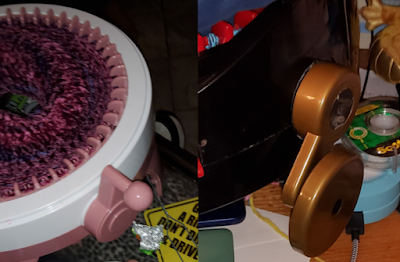
Image: The Sentro machine is on the left with a purple project in its center. The small, pink handle/crank has a ball on the end. The right side has the Addi machine with its handle prominent; it's larger with a thick, flat circle on the end to grab.

If you're looking for a less expensive loom knitting machine, you might want to try Sentro brand knitting machine. The Sentro comes in three different sizes: 22 needles, 40 needles, and 48 needles. The 22 needles size costs around 40 dollars on Amazon, the 40 needles one costs around 50 dollars, and the 48 needles costs about 70 dollars.

Things I like about the Sentro are:

The price

The included tensioner you put on the machine (makes one-handed knitting easier)

Handle shape is smaller and easier for me to grasp

Suction cups on the legs (I can’t use a clamp on my tray, so they help the machine remain stationary)
~*~
The one thing I don't like about the Sentro is how, if you accidentally hit the reset button on the row counter, there is no way for you to go back.

P. S. The reason I started looking into the Sentro is because shortly after I bought my Addi the handle broke. The handle for the Addi set me back about 30 dollars, and it shipped from Germany. Also, a tensioner for my Addi costs eight dollars… I’m already on my second one.

Friday, February 18, 2022

A Case Against Agents

Agents are heralded as champions of novelists. Many writers think their first step after finishing the book (if they aren't publishing it themselves) is to start finding one. But, there are many truths about agents you will not be told.

1. Agents get your money first.
Your agent is supposed to take their 15% before you get your share of royalties or advance payments. So, they get their hands on your money before you even see it (delaying your payday). Unsurprisingly, it's easy for them to skim off extra. If they do, they rarely get caught because people taught to trust their agents won't double-check. How well do you know someone over a dozen phone calls and emails?

2. Querying an agent is like submitting to a publisher.
So many spoonies tell me they don't have the energy to do round after round of submissions to publishers, but querying an agent and submitting your book to a publisher are quite similar; it can take years and dozens of attempts to get anyone's attention. Since a lot of writers go through more than one agent in their lifetime, agents are not a guarantee you won't have to submit/work your ass off for future projects.

3. Anyone can become an agent.
There are no formal requirements to becoming an agent. The best agents have knowledge of the industry, working relationships with various publishing houses, and a passion for books. But, nothing prevents a random person from printing out a business card and accepting clients.

4. Agents are more gatekeepers.
Authors from marginalized groups face even more considerations when dealing with gatekeepers. Will one book by a crip be labeled "enough" in the agency? Will agents not bring your books to the larger houses because they assume the "niche" novel by a neurodivergent writer won't sell? Editors pose plenty of hoops by themselves.

5. Agents can negotiate contracts without a law degree.
To clarify, I'm not saying someone has to have a degree to negotiate a contract (you can even attempt it after teaching yourself), but it's a mistake to automatically think they will always do a better job than a self-educated author. If you are scared you'll mess something up, there are IP lawyers you can pay who can get you better terms... without taking 15% of your royalties indefinitely. Plus, an agent might be more concerned with their relationship with a certain editor or publishing house than giving you what you deserve (you are one smaller client out of a dozen).

6. You don't need an agent to get published.
A lot of publishing houses have reading periods. Getting into one of the Big 5 (maybe the Big 4 soon) might not be directly possible, but even the largest houses can have hungry imprints that will consider manuscripts directly from authors. 

7. Agents aren't the only cheerleaders.
Some agents can be fuzzy cheerleaders, but so can other people in your life. If the main thing you're looking for is someone to lift you up during the writing and submitting process, you can join a writers' group or turn to a friend.

8. Agents can have terrible contracts.
Agent one had her author break up with her but can still get the 15% on a project she negotiated for the author years ago. Agent two won't submit a children's book for his once horror-writing client but will get 15% of the royalties should the author sell it themselves. Yet another agent makes money even when her client self-publishes. I know it seems like a "know what you're signing" warning (it is), but it's easy to slip an unfavorable clause somewhere. 
~*~
I know most writers and publishing professionals tell you an agent is necessary to navigate the waters, but most people telling you to get one tend to sweep the negatives under a rug they hope you don't move. Poets and other niche writers are advised (correctly) against trying to secure representation, anyway.  Agents are far from your only way into traditional publishing, and I hope you weigh every option in front of you before choosing your route. I'm cheering for you.

Further reading:

Dean Wesley Smith has a lot of older posts on agents. He and Kristine Kathryn Rusch are firmly against agents and negotiate contracts for themselves.


Friday, February 11, 2022

That Hurts by F.I. Goldhaber

You slapped me on the shoulder,
the one I dislocated
many years ago. That hurts.

You reach out to shake my hand.
I point to the hidden splint.
You grab for the other, but
I wear a brace to protect
it too. Even if you just
gently squeeze either of my
enervated hands, that hurts.

I must dodge and defend from
amiable aggression,
affectionate attacks, and
affable abuse that hurts.

Your cordial clap on my back
wakens persistent pain and
requires ice to recover,
costs me the ability
to attend an event or
write a new poem. You stole
one of my spoons and that hurts.

Why is it acceptable
to slam strangers, cuff colleagues,
bash buddies without consent?

Don't touch me. That always hurts.


~*~
Biography: F.I. Goldhaber's words capture people, places, and politics with a photographer's eye and a poet's soul. As a reporter, editor, business writer, and marketing communications consultant, they produced news stories, feature articles, editorial columns, and reviews for newspapers, corporations, governments, and non-profits in five states. Now paper, electronic, plastic, and audio magazines, books, newspapers, calendars, broadsides, and street signs display their poetry, fiction, and essays. More than 180 of their poems appear in almost 80 publications including four collections. http://www.goldhaber.net/