Friday, February 25, 2022

Sentro Knitting Machine by Spazzy Crafter

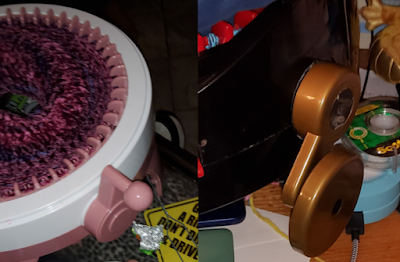
Image: The Sentro machine is on the left with a purple project in its center. The small, pink handle/crank has a ball on the end. The right side has the Addi machine with its handle prominent; it's larger with a thick, flat circle on the end to grab.

If you're looking for a less expensive loom knitting machine, you might want to try Sentro brand knitting machine. The Sentro comes in three different sizes: 22 needles, 40 needles, and 48 needles. The 22 needles size costs around 40 dollars on Amazon, the 40 needles one costs around 50 dollars, and the 48 needles costs about 70 dollars.

Things I like about the Sentro are:

The price

The included tensioner you put on the machine (makes one-handed knitting easier)

Handle shape is smaller and easier for me to grasp

Suction cups on the legs (I can’t use a clamp on my tray, so they help the machine remain stationary)
~*~
The one thing I don't like about the Sentro is how, if you accidentally hit the reset button on the row counter, there is no way for you to go back.

P. S. The reason I started looking into the Sentro is because shortly after I bought my Addi the handle broke. The handle for the Addi set me back about 30 dollars, and it shipped from Germany. Also, a tensioner for my Addi costs eight dollars… I’m already on my second one.

Friday, February 18, 2022

A Case Against Agents

Agents are heralded as champions of novelists. Many writers think their first step after finishing the book (if they aren't publishing it themselves) is to start finding one. But, there are many truths about agents you will not be told.

1. Agents get your money first.
Your agent is supposed to take their 15% before you get your share of royalties or advance payments. So, they get their hands on your money before you even see it (delaying your payday). Unsurprisingly, it's easy for them to skim off extra. If they do, they rarely get caught because people taught to trust their agents won't double-check. How well do you know someone over a dozen phone calls and emails?

2. Querying an agent is like submitting to a publisher.
So many spoonies tell me they don't have the energy to do round after round of submissions to publishers, but querying an agent and submitting your book to a publisher are quite similar; it can take years and dozens of attempts to get anyone's attention. Since a lot of writers go through more than one agent in their lifetime, agents are not a guarantee you won't have to submit/work your ass off for future projects.

3. Anyone can become an agent.
There are no formal requirements to becoming an agent. The best agents have knowledge of the industry, working relationships with various publishing houses, and a passion for books. But, nothing prevents a random person from printing out a business card and accepting clients.

4. Agents are more gatekeepers.
Authors from marginalized groups face even more considerations when dealing with gatekeepers. Will one book by a crip be labeled "enough" in the agency? Will agents not bring your books to the larger houses because they assume the "niche" novel by a neurodivergent writer won't sell? Editors pose plenty of hoops by themselves.

5. Agents can negotiate contracts without a law degree.
To clarify, I'm not saying someone has to have a degree to negotiate a contract (you can even attempt it after teaching yourself), but it's a mistake to automatically think they will always do a better job than a self-educated author. If you are scared you'll mess something up, there are IP lawyers you can pay who can get you better terms... without taking 15% of your royalties indefinitely. Plus, an agent might be more concerned with their relationship with a certain editor or publishing house than giving you what you deserve (you are one smaller client out of a dozen).

6. You don't need an agent to get published.
A lot of publishing houses have reading periods. Getting into one of the Big 5 (maybe the Big 4 soon) might not be directly possible, but even the largest houses can have hungry imprints that will consider manuscripts directly from authors. 

7. Agents aren't the only cheerleaders.
Some agents can be fuzzy cheerleaders, but so can other people in your life. If the main thing you're looking for is someone to lift you up during the writing and submitting process, you can join a writers' group or turn to a friend.

8. Agents can have terrible contracts.
Agent one had her author break up with her but can still get the 15% on a project she negotiated for the author years ago. Agent two won't submit a children's book for his once horror-writing client but will get 15% of the royalties should the author sell it themselves. Yet another agent makes money even when her client self-publishes. I know it seems like a "know what you're signing" warning (it is), but it's easy to slip an unfavorable clause somewhere. 
~*~
I know most writers and publishing professionals tell you an agent is necessary to navigate the waters, but most people telling you to get one tend to sweep the negatives under a rug they hope you don't move. Poets and other niche writers are advised (correctly) against trying to secure representation, anyway.  Agents are far from your only way into traditional publishing, and I hope you weigh every option in front of you before choosing your route. I'm cheering for you.

Further reading:

Dean Wesley Smith has a lot of older posts on agents. He and Kristine Kathryn Rusch are firmly against agents and negotiate contracts for themselves.


Friday, February 11, 2022

That Hurts by F.I. Goldhaber

You slapped me on the shoulder,
the one I dislocated
many years ago. That hurts.

You reach out to shake my hand.
I point to the hidden splint.
You grab for the other, but
I wear a brace to protect
it too. Even if you just
gently squeeze either of my
enervated hands, that hurts.

I must dodge and defend from
amiable aggression,
affectionate attacks, and
affable abuse that hurts.

Your cordial clap on my back
wakens persistent pain and
requires ice to recover,
costs me the ability
to attend an event or
write a new poem. You stole
one of my spoons and that hurts.

Why is it acceptable
to slam strangers, cuff colleagues,
bash buddies without consent?

Don't touch me. That always hurts.


~*~
Biography: F.I. Goldhaber's words capture people, places, and politics with a photographer's eye and a poet's soul. As a reporter, editor, business writer, and marketing communications consultant, they produced news stories, feature articles, editorial columns, and reviews for newspapers, corporations, governments, and non-profits in five states. Now paper, electronic, plastic, and audio magazines, books, newspapers, calendars, broadsides, and street signs display their poetry, fiction, and essays. More than 180 of their poems appear in almost 80 publications including four collections. http://www.goldhaber.net/

Friday, February 4, 2022

Review of Leaf Memories by Carol Farnsworth


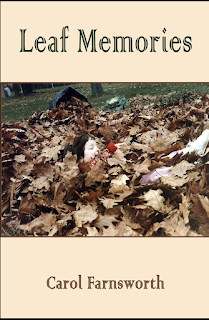
Image: In the center is a photograph of a girl semi-covered in a pile of brown leaves. The girl is wearing a red sweater, white sneakers, and light colored pants. Her eyes are closed. She has straight, dark hair. The top of the image is a sand color with the title of the book in khaki. The bottom of the image is the same with the author's name.
Note: I was given a copy of this book in order to review it.

Wrinkled creases cover your cheeks.
You cry grey tears from cinder hills.
Burnt pine cones start the mend.

-From "Burnt Over"

Leaf Memories by Carol Farnsworth is a nature poetry chapbook interspersed with the occasional photograph in black-and-white. It is divided into sections by season. Each season begins with a grouping of haiku-like poetry sharing the same page. The division makes it a clear and easy read. 

A fall breeze begins to blow
Leaves are eager to start the show.
Dressed in hues of yellow, orange and red,
They hold on tight as the wind spreads.

-From "Tiny Dancers"

Each piece in this collection is awash with color, sound, and motion. Carol's attention to detail is exquisite and delicate. I felt as though I could see each poem just as she describes. Bits of humor can be found inside certain poems like small gifts.

snowflakes pile
crystal on crystal
creates dreamscapes

- "Flakes"

A few poems almost read like miniature lyric essays. "Beauty in the Field" and "With the Wind" are two examples of the work taking on a more fluid scope. They are small journeys to move through.

Two instances (that I can remember) make note of humanity's carelessness/destruction of the beauty of nature. I found this welcome, especially since most nature poets either brush it aside or make it a focus. It appears Carol comes to nature from a place of wonder and respect.

Rain distorts the reflection in the pane.
I contemplate my twisted hold on reality.
Memory of the visual world changes with age,
reforming like a deck of shuffled cards.

- From "Reflections"

Carol Farnsworth wrote these poems shortly after she lost her sight entirely. The last section of the book is "Spring"; it seems to be done with careful intent... leaving readers at a place of beginning.

I recommend this book to any fan of nature poetry.

~*~

Biography:  My name is Carol Farnsworth. I have worn many hats in my life. Trained as a Speech Pathologist, I have worked with children and adults with cognitive and language disorders. My leisure time was spent in a community acting group, singing in a chorus, and teaching Hawaiian dance at a local studio.

Six years ago, I struck my one eye losing the rest of my usable vision. I enrolled in a course in Braille and started to write for the local Association for the Blind newsletter. Through Hadley School for the Blind, I learned of a writers with disabilities group. Joining in early 2019, I have learned from fellow writers to practice writing poetry and short stories.

In March of 2020, I started a bi-weekly blog about living with blindness while seeing the humor in daily situations. Blog posts consist of a short article and a poem. https://blindontheliteside.com

During my association with Behind Our Eyes, I have been published in Spiritfire Review, Breath & Shadow, The Avocet, and the B.O.E.'s magazine, Magnets and Ladders.

Additionally, I write a monthly article for the Blind Perspective and Newsreel audio magazines.

More information on Leaf Memories: https://www.dldbooks.com/carolfarnsworth 

Friday, January 28, 2022

Opening Soon (and News)

General submissions will open on Tuesday, February 1st! We have a new interviewer on staff this year (welcome aboard, Mr. Vera!); interview requests now have their own email address.

The Cripendy Contest will be open from February 1st through April 15th. I'm hoping for even more entries this year! Please?

Since we don't have enough volunteers this term, the mentor program will not be running. We'll try to have everything squared away for late summer with more than two mentors on deck. If any poets or speculative flash fiction writers need a little guidance, I'm around to answer questions or bounce ideas off of.

We're also considering starting a Discord server for our community by the end of 2022. We welcome all discussion of the idea as well as suggestions and volunteers to make it as accessible and friendly as possible.

Thank you for reading. We hope to hear from you soon!

Friday, October 29, 2021

Using the Addi Express (Two Sizes) by Spazzy Crafter

Image: A round, black, plastic machine with red pegs (except for two white near the shuttle). There are a few rows of blue yarn on the pegs, and the yarn ball sits a few inches away. The background is a tile floor.
If you like to loom knit and are looking for a way to do it more independently, then the Addi Express (with 22 needles) and the Addi Express King Size (with 46 needles) are for you. They are a series of hand-crank knitting machines from Germany.
We should now talk about the price. The Addi Express and the Addi Express King Size price varies depending on where you get them and if you want them as a bundle. They can run anywhere between $170 to $430 USD.

Yarns that work:

It takes a lot of trial and error, but medium weight yarns are generally recommended. Since the machine is made in Germany, DK (double-knit yarn) might be the best; the US equivalents are gauges seven, eight, and nine. If you use thicker/thinner yarn, the machines will drop stitches. Performance can also vary between yarn brands and amount of tension.

What comes with:

Extra needles in case they break, one tapestry needle (per machine), stoppers (these are included with some machines), instructions, and the machines themselves. There is a row counter on the machine.

Using the Addi:

Cast on the yarn by starting at the first black peg on the right. All the pegs have a hooked top. Put the yarn in the hooked part, then put the yarn behind the next peg, and continue alternating going in front and behind the pegs until you make it all the way around the loom. Place the yarn strand in the shuttle and close the little door. Rotate the handle to cast on all the pegs and keep rotating until you get the desired number of rows. The tapestry needle is used to collect the stitches from the pegs when you’re ready to finish the project.

Pros and cons of the Addi Express:

The major pro for me to the Addi Express is that I only need help with the casting on and the binding off. It takes about a half hour to make a hat. It can also make panels for things like baby blankets; there is a switch for round or panel knitting.

The major con is the price. It can drop stitches because it doesn't come with a tensioner.

Extras for separate purchase:

A tensioner makes one-handed use easier
Suction cups for the legs (I haven’t tried them yet)
Clip weights might also help with dropping stitches
Image: The left side has a smaller machine with white yarn cast on and a ball of yarn nearby. The background is a quilt of varied colors with rounded shapes separated by small, checked squares. The right side of the image is the finished product... a white hat.
There are cheaper knitting machines out there (like the Sentro), but I haven’t tried them. Some come with a tensioner built in. 

Friday, October 22, 2021

Interview with Author Ciaran J. McLarnon

Image: A headshot of a caucasian man in a printed, button-down shirt. He has thick, black glasses and receding dark hair. He is outdoors (grass, trees, and sky visible).

When did you figure out you wanted to be a writer?

When I was studying for my MSc I read Silent Spring by Rachel Carson and was blown away by what she had achieved. Until that point I had been making a choice between being a scientist and being a writer, but that book made me think I might be able to do both. A few years later I accepted that being an ecologist was no longer on option for me, and I decided to focus on writing. Now I can't imagine ever being anything else. That feels strange because (if I wasn't disabled) I'm not sure how I would have ended up being a writer, but I really think I was never going to be anything else.

Who are your influences?

Rachel Carson has been a major influence, as have many other nature writers; I really enjoyed reading Henry David Thoreau and like to keep him in mind when I write. I spent my childhood in the area where the poet Seamus Heaney had grown up 50 years before and aspire to write stories with the panache of his poetry. There are many Irish writers who inspire me to try and be better every day. Of more recent writers Kazuo Ishiguro is a favourite, an excellent storyteller with unrivalled technique. Like many writers, I’m also a keen reader and hope that every book I read influences me in some small way.

Where did you get the inspiration for your debut novel New Shores? How long did it take you to write?

New Shores first started its life as a short story about six years ago. At that time I had no desire to write a novel, but I knew that if I ever did, that story would be the place from which I would start. About 18 months later that opinion had changed and I began to write the first draft of the novel. I chose New Shores because it was an area where no amount of research would be too much, and because I thought I could add something to the work available that tackled the same subjects.

The original short story was inspired by a lecture series I attended at university on the native tribes of Papua New Guinea, and by a TV report which detailed how tribes in Papua New Guinea moved away from the coast after a tidal wave because they were scared of the sea. Hunter/gatherer tribes in places such as Papua New Guinea are often used to examine how prehistoric people might have acted in certain situations.

How did you become interested in environmentalism and history?

I grew up in a very rural area, so I've always had an affinity for nature because of that. My studies in Marine Biology and Ecology focused heavily on the environment. To me environmentalism just makes sense; it's a little like recognising that a house is going to need maintenance occasionally, and that you should avoid doing things that might damage it.

I also like to know the source of ideas, and that's where my interest in history comes from. Plus, history is full of great stories and interesting characters that I think people will enjoy learning more about, and the ideas from history can teach us a lot about human nature.

Do you have any advice for people wanting to research or write about people and things outside of their culture?

It's tricky since most writers don't want to be accused of cultural appropriation. I try to be respectful and understanding, and if you can do that, then people are usually more forgiving if you are inaccurate. You will make mistakes and people will see things in a different way, so try not to be too controversial. I'm from Northern Ireland so I have heard people try to advise on the situation here, so any researcher might want to avoid a very complicated situation. But subjects outside a person's cultural experience shouldn't be too daunting - everyone has their opinion and an objective opinion could be useful. Any comments should be necessary, as simple as they can be, and show people you have tried and want to understand.

What was the aspect that surprised you most about the publishing process? Is there anything you wish you would've done differently?

I thought being in control of the final book that emerged from the publishing process didn't really matter that much to me, so I was surprised to find out how wrong I was about that. Through Atmosphere Press I felt like I had the final say in the design and editorial process, which I found empowering. I suppose, after spending so long thinking about my words, I didn't want anyone else to have that much control over them!

Do you have a writing routine?

I do have routine, but it's become more flexible recently. I do like to try and follow the advice of Stephen King to try and write every day. Three days a week I go to the gym after breakfast, and physical exercise is an important part of my process. I often take breaks during writing to exercise. After I get back from the gym, or straight after breakfast on the mornings that I don't go, I like to read for about 90 minutes. I then write for about two or three hours or until I get stuck. Then read again for about 90 minutes, something different from what I was reading that morning. If I have something I really need to do, I will read/write in the evening. Having a strict routine helps me to avoid procrastination and write when I’m not motivated.

Are you more of a "plotter" or a "pantser"?

For New Shores I was definitely a pantser; I just had a vague idea of how things were going to go before I started writing. The world and the story got more solid with each draft that I wrote, but because I was researching and reading as I went, I'd written three or four drafts before all the major plot points appeared. Plotting probably would have made editing faster. For the next book, I'm writing a three-sentence summary before I begin each chapter, but I don't want to plot too much because making up the story as you write it is part of the fun!

A lot of writers seem to recommend plotting and I do like to have a vague idea of the beginning, middle, and end before I start. But, I change my mind so often that I don’t think I should plan too much. I think a writer should have a plan but needs space to be creative.

What is the biggest challenge you've faced as a disabled writer?

Because of my medical condition, I have difficulties holding small objects and can’t use a pen and paper. It has never been a problem that has made me reconsider writing, but I do get the feeling that my process is a little different from the process of authors who can use pen and paper. For example, I have never written in the margins of a book or used a highlighter pen. I'm a slow typist too and I have used several methods to get over these problems.

The first method I used and by far the best was a note taker, a person whose job it is to take notes for you and to write down what you say as appropriate. I used this method in a creative writing class I attended a few years ago, but it was in a large university that could afford to hire a note taker and had empty classrooms I could use when dictating.

The computer programme that I use for dictation now works out pretty well. I'm using it to complete this interview. The programme does pick the wrong words sometimes, but I think that problem is mainly due to my thick accent! When using any kind of dictation is inappropriate, I often use a tablet. This is the solution I normally opt for when I'm attending a writing class or workshop. I produce shorter pieces than most people in that situation, but I still enjoy learning about writing and listening to other people’s work.

What project are you working on next?

I usually split my time between writing novels and writing short stories. I write short stories until I need to stop and start working on my novel again, which usually takes four months. Then I'll write that novel until I feel like writing short stories again. Right now I'm on the short story part of the cycle, but I’ll turn to the 3rd draft of my next novel by January 2022.

The novel writing is going pretty well and I think it’s starting to take shape. With a little planning, I think I can reduce the number of drafts and maybe complete the book in 2022. Some interesting things are happening to the main character so I'm quite looking forward to seeing how it all works out. I'm trying my hand at dark fantasy in the short story I'm currently working on and the short stories I've been working on most recently are historical fiction and for a nature writing competition. I just heard that my historical fiction piece will be published so I'm pleased by that.

~*~

Biography:  Ciaran J. McLarnon is a Northern Irish writer who lives in the town of Ballymena, north of Belfast and close to dramatic scenery that has inspired many filmmakers and other artists. Renowned poet Seamus Heaney, winner of a Nobel Prize for literature, was born in the area and is one of many writers who inspire Ciaran.

Ciaran has a BSc in Marine Biology and an MSc in Ecology, both of which strongly influence his writing. Medical problems encouraged him to develop a life-long passion for fiction since that time. His continuing quest to hone his craft has explored many different subjects including history, the natural environment, horror and crime. Although this is his first novel, his words have featured in many publications, and he was long-listed for the Adelaide Literary award. More information on Ciaran J. McLarnon and his works is available at ciaranjmclarnon.blog.