Showing posts with label Book Review. Show all posts

Friday, May 26, 2023

The Autumn Ghost by Hannah Wunsch (Review)

A black and white photo of a female med student standing near a patient's bed, manually pumping a ventilator balloon so a child can breathe. Another student (a man with glasses) sits to the left of her. The title is in white with the subtitle near the bottom in small, yellow text.

Note: I received this in order to review it.

The subtitle of this book (How the Battle Against a Polio Epidemic Revolutionized Modern Medical Care) is incredibly accurate. Did you know the first true ICU was created in Denmark by an anesthesiologist who realized the benefits of such a department because of what he saw during a polio outbreak in 1952? We also have modern blood gas tests due to the necessity of frequent pH checks of polio patients' blood.

The story is structured a bit like a medical mystery. A lot of the focus is on a hospital called the Blegdam, the only contagious disease hospital in Copenhagen. The author even goes through how hospitals in the city helped hide Jewish people and assisted the Danish resistance in World War II; the war shaped alliances between doctors into the 1950s. A good amount of the narrative goes into the deluge of polio cases during the aforementioned summer of 1952. 

I thought this book was going to be dry, but it's actually full of life and many interesting tidbits. Most people introduced (researchers, doctors, and patients) in this book have photos and pieces of their personalities sprinkled in. The reader hears what happened to them after the disease left their lives and what came next, if anything. Not all endings are happy. 

The medical terminology and inventions were presented in a way I understood. It was cool knowing what industries gave the medical field certain innovations or improvements.

Medical experiments on animals were brought up fairly often. If you're the type of person who doesn't want to read how animal testing leads to breakthroughs or setbacks in the medical field, you might need to skip this read. It goes far beyond the typical experimentation on mice. Another thing that might upset readers is the trial vaccine given out at schools/homes for the "feeble-minded" with no guidelines in place (or, at points, consent); but there are only two brief instances mentioned. 

A lot of historical context is given, especially if there was a device or concept floated around well before an equivalent is introduced in the 1940s or 1950s. For instance, the idea behind the iron lung existed way before the ones we currently think of were on the market. 

I learned a lot from this book and don't regret a minute I spent reading it. I even learned the story behind the creation of the boardgame Candy Land. I recommend this book.

Friday, May 5, 2023

Book Review: These Gossamer Strings by Allegra Pescatore

A blond, white woman sits on the grass by a river in a faded denim-colored robe. The sky is dark with reddish clouds. A small, white dragon sits behind the woman facing to the left with its tail curved into the water.
Note:
I received a copy of this book for free.
There will be minor spoilers of the series (including this book).

Elenor has less than three weeks left before she faces a tribunal for her father's murder and must complete the rite that ensures she stay on her throne. As if Elenor didn't have enough to deal with, her mother is still missing, her diabolical aunt threatens the life of someone she loves, one of her best friends wants to kill her, and she's going through a flare.

Her allies have secrets and loyalties soon to be revealed:
Gabe's heritage might save the continent or damn it.
Daemon's wicked past comes back around.
Fedrik might be Elenor's savior or executioner.
Her mother both loves and hates her.

All the pieces are in play for the final installment of the first arc of the
Last Gift series.

There is a fair amount of action in this book: Chase sequences, battles of magic, explosions, and hand-to-hand combat all occur. Everything is described with enough skill so I knew what was happening without the passages being repetitive. There is torture in this book but far less than the novel where Gabe was kept in the dungeon.

Everyone's motivations (whether complex or simple) are fully presented as they act. Those of moral ambiguity (like Dae) are given the leeway to inhabit or change who they are. I can see even the minor characters as full people in my head, and it's not just because they are described as physically diverse. I will say I wasn't thrilled with the outcome of two characters: Prince Cassian and North because I felt like, though their motives made sense, they left me with a sense of wrongness.

All the various settings are still gorgeously described without bogging anything down.

One of the gripes I had with the first book was not knowing much about the motivations of the main villain. But this book puts so much in perspective as we get to know Elenor's mother; she has so many secrets connecting the dots on Elenor's father that it felt like we finally got a real look at what drove him. I still hated him at the end (and his wife somewhat, too) but still.

The book goes at a good pace while leaving room for character development and surprises. Every chapter felt necessary. 

Elenor and Gabe have more than one discussion about the use of her painkiller. As her physician, he often tries to warn her away from a higher dosage because of the potential risks. She argues that she's taken the drug for over thirteen years and knows her body's limits. I thought this debate (one chronic pain patients have all the time) was an excellent inclusion. To his credit, Gabe never accuses her of being an addict or threatens to take her meds away.

There are large threads of hope, perseverance, found family, and redemption even during the darker parts of this series which I appreciate... especially since some sections can get quite grim.

If you're expecting a neat bow on the ending, you'll be disappointed. While some of the threats are gone by the epilogue, some manage to escape and others appear at the end. This series is definitely far from over. But I loved it, recommend it, and can't wait for the next arc!

Friday, April 29, 2022

Prosthetic Gods: Jonathan Penton (Review by Su Zi)

Black and white drawing. A large planet and rocketship are over the heads of three figures. So figure on the right looks alien, and the figure on the left looks like a man with a partial face. There is another figure in the middle that is humanoid. The title of the book starts on the planet and extends on an angle outward across the top of the picture. There are little asteroids dotting the sky.

Dark material can be difficult for some readers; work that is violent, even when it rhymes, can feel as if the song itself, the poem itself, the art itself is an assault. Those familiar with contemporary genres in music or cinema are no strangers to violence in art; however, not every reader of poetry is accustomed to violence as a thematic element in a chapbook. A reader who is disabled, or is sensitive to disability justice, will notice the book’s title Prosthetic Gods, as disabled folk who live with prosthetic aids are often socially marginalized. While the title refers to a remark made by Freud, and the remark is included in the book’s initial pages, the title itself serves as a warning of this chapbook’s raw content.

Of course, those familiar with punk as a multi-genre philosophy, will also recognize the energy here. The black and white cover features a delicate drawing of subtly grotesque figures apparently in conversation during a rocket launch, and the volume of less than thirty pages uses a nice weight of paper—a testament to the work’s second edition status. Also, the spine is perfect bound, which is unusual in a book of such brevity. One wonders maybe if the first edition didn’t have that wonderful copy shop at midnight look, crooked stapling and all.

The eight titles of the poems also indicate a punk sensibility in this work, with the opening title being “First Mind Buried”, although an untitled poem precedes it. Indeed, Penton’s punk sensibility becomes revealed in this poem’s fifth line “cheap fucks who rent their stolen suits”(6), and there’s an odd use of taboo language through the volume. The punk genre makes full use of impolite terms, but what’s curious is how in “Sin of the Calf” (10), Penton eliminates the vowel to write “g-d” but also uses “fucking” in the same line. There’s no particular spiritual reverence otherwise present in the poem—or the book itself—and punk was notable for its use of deliberate irreverence. 

There’s lots of use of impolite biology in this work; the prologue poem’s longest line is “your ink a mix of sweat, tears, vomit, and blood” and the writing grows increasing in violence, with perhaps a culmination of sorts in a section titled “Maror”. There’s four poems, or sections on separate pages under the title, with the last of these beginning with the rather elegant line “Venus walks among us, invisible and stalking”(14); however, this is not a lush and romantic symbol, but a destructive one who “murders their parents” and continues on with a horrific litany of intimate destruction.

While some readers might dismiss the work as merely the sort of punk porn posture assumed by many practitioners of the genre, there’s ample evidence of horror genre: a poem dedicated to Stephen King involves domestic violence and a nascent mass shooter, and the violence of the poems lends itself well to that genre. Yet, the repeated use of unsavory biologic imagery goes further than the plot of a regular person beset by demons. In “Don’t Let me Give You a Title”, the poem takes a kind of Prufrock journey, “You move smoothly, easily/among these discharged minds/their walls of blood and puke”(20) with the poet’s response being “but you feel more you than ever”. This is not the writer witnessing otherness around him, but rather the writer’s discovery of his own otherness in the least attractive aspects of those he encounters.

While this work may not be an overt testimonial to the author’s identity as other-minded, or neurodivergent, Penton’s participation in a panel on neurodivergence at AWP might be. In the realm of ND activism, there’s debate about which characteristics are also Disability or Crip issues, with some disabled people even objecting to Crip as a title. Nonetheless, the familiarity with the less-than-glamorous aspects of our biology is a fat realm in disability discussion, and has been weaponized against disabled people in a variety of ways in our culture. Just as classical punk was a genre-crossing philosophy, and as disability crosses all social castes among us, experiencing Penton’s chapbook is a visit to both of these realms in an intersection beyond sexual identity alone, or horror alone. Perhaps Penton’s poems here might find welcome if viewed as CripPunk, an energetic arts consideration which seeks revisionist historical acknowledgement of disability in classically accepted artists. While disability in the arts is ever uninvited, and occasionally tokenized, in the literary culture, Penton makes no apologies for his rage: “Let me suffer without any comforts/And the lies that you tell to make your lies worth living/Can rot with the flesh of our culture”(26). The rage of the disabled has almost come within earshot of the wider culture in these years since the beginning of COVID; the rage against the machines that tout a false narrative of normalcy are now coming from voices previously marginalized into invisibility. Our news cycles ever display yet more ugly from the abled towards everything around them, a genuine horrorshow from which literary horror seems a calm respite. Penton’s poetry here bridges the prosaic horror of lives thought to be ordinary, and does so with an artful mix of vernacular language and an elevated ear.

~*~


Biography:
Su Zi is a poet/writer and artist/printmaker and edits, designs and constructs the eco-feminist poetry chapbook series Red Mare.

Publications include poetry, essays, stories and reviews that date back to pre-cyber publishing, including when Exquisite Corpse was a vertical print publication, and a few editions of New American Writing. More recent publications include Red Fez, Alien Buddha, and Thrice. A resident of the Ocala National Forest, with a dedicated commitment to providing a safe feeding respite for wild birds, and for a haphazard gardening practice that serves as a life model for all aspects of her work.

Friday, March 25, 2022

Book Review: Whispers of Stone by Allegra Pescatore

                         A white man with dark brown hair and a beard stands in front of a fence with trees and a palace behind. He has a small, white dragon on his shoulder. He wears a long dark jacket and trousers. In one hand he holds a satchel at his side and the other holds a golden circuit. The author's name is in white across the top and the bottom has the title written in gold.

Note: I received a copy of this book in order to review it.
There will be brief mentions of rape (a slight spoiler), racism, and ableism.

Picking up directly after Where Shadows Lie, our protagonists find themselves in various states of danger. Elenor's father is dead, and she is accused of his murder; it doesn't help that her mother is missing and her scheming aunt has arrived in the kingdom. Gabriel has aligned himself with Elenor while trying to control his unlocked magical potential. Fedrik has an ability that just might doom the world... even with Fayrian's help. Daemon keeps ticking off the wrong beings. And a golden god seeks vengeance for the death of another.

I loved the first book, so I was a bit skeptical going into this one as sequels can often disappoint. There are more books to the universe than I thought, and I only found out about them in this book. The book is split in two due to length (the next book arrives this summer). Despite my concerns going in, they proved unfounded. The series is in a universe with other books (but can stand alone). While much is left unresolved in this book, it doesn't leave me feeling like I'm on a ledge waiting for rescue.

The characters feel genuine. Elenor anguishes over her past decisions and deals with the impact of an illness flare (which can affect her ability to make decisions). Fedrik is lost and dealing with the fury his new Gift gives him. Fayrian is still a smartass, but she also has a small sense of hope underneath. There are a lot of tough emotions in this novel but also tiny sparks of strength and joy.

There are a few minor characters with various disabilities. Phoebi is a grandmother with cerebral palsy. Mari is an amputee who had her hands cut off for being part of the rebellion. Suela has no eyes. I'd say Alehan has PTSD, but it isn't confirmed.

Schemes and plans are amped up in this installment. Elenor must find a way to get out of her aunt's terrible trap. Each god has plans (and pawns) that continue to move forward. I could feel the clock ticking, and I'm excited to see what the author does going forward because there are a lot of threads to tie together.

The world still feels like a real place. Readers are given more details on the complex (and somewhat unique) magic system. Places come alive with just the right amount of detail. The lore is evolving with each book. Supplemental materials (including a recap of the first book) exist in the back of the novel to assist readers with remembering characters and events.

Ableism and racism are vaguely present in this world. I counted one instance of each. 

Spoilers: At one point in the book, Elenor has sex with someone she doesn't want due to blackmail. I consider this a type of rape, though the person she beds isn't the one blackmailing her. She is given a tea to make sure an unwanted pregnancy doesn't occur.

There was a novelette after the book that details the time Gabriel spent caring for victims of an epidemic during his last year in school. The doctors go through burnout, there aren't enough beds or medications for everyone, and certain patients are immediately given palliative care because they aren't considered worthy of saving. Yes, it's very reminiscent to the pandemic we just went through, but the illness and the devastation it caused parts of the world were already present in the book before COVID-19 came about. Even so, it might be hard to read for some people.

I definitely recommend this book and have high expectations for the next one!

Friday, February 4, 2022

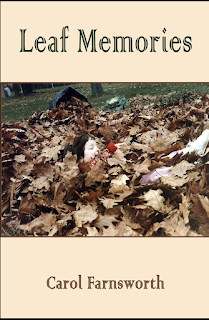
Review of Leaf Memories by Carol Farnsworth


Image: In the center is a photograph of a girl semi-covered in a pile of brown leaves. The girl is wearing a red sweater, white sneakers, and light colored pants. Her eyes are closed. She has straight, dark hair. The top of the image is a sand color with the title of the book in khaki. The bottom of the image is the same with the author's name.
Note: I was given a copy of this book in order to review it.

Wrinkled creases cover your cheeks.
You cry grey tears from cinder hills.
Burnt pine cones start the mend.

-From "Burnt Over"

Leaf Memories by Carol Farnsworth is a nature poetry chapbook interspersed with the occasional photograph in black-and-white. It is divided into sections by season. Each season begins with a grouping of haiku-like poetry sharing the same page. The division makes it a clear and easy read. 

A fall breeze begins to blow
Leaves are eager to start the show.
Dressed in hues of yellow, orange and red,
They hold on tight as the wind spreads.

-From "Tiny Dancers"

Each piece in this collection is awash with color, sound, and motion. Carol's attention to detail is exquisite and delicate. I felt as though I could see each poem just as she describes. Bits of humor can be found inside certain poems like small gifts.

snowflakes pile
crystal on crystal
creates dreamscapes

- "Flakes"

A few poems almost read like miniature lyric essays. "Beauty in the Field" and "With the Wind" are two examples of the work taking on a more fluid scope. They are small journeys to move through.

Two instances (that I can remember) make note of humanity's carelessness/destruction of the beauty of nature. I found this welcome, especially since most nature poets either brush it aside or make it a focus. It appears Carol comes to nature from a place of wonder and respect.

Rain distorts the reflection in the pane.
I contemplate my twisted hold on reality.
Memory of the visual world changes with age,
reforming like a deck of shuffled cards.

- From "Reflections"

Carol Farnsworth wrote these poems shortly after she lost her sight entirely. The last section of the book is "Spring"; it seems to be done with careful intent... leaving readers at a place of beginning.

I recommend this book to any fan of nature poetry.

~*~

Biography:  My name is Carol Farnsworth. I have worn many hats in my life. Trained as a Speech Pathologist, I have worked with children and adults with cognitive and language disorders. My leisure time was spent in a community acting group, singing in a chorus, and teaching Hawaiian dance at a local studio.

Six years ago, I struck my one eye losing the rest of my usable vision. I enrolled in a course in Braille and started to write for the local Association for the Blind newsletter. Through Hadley School for the Blind, I learned of a writers with disabilities group. Joining in early 2019, I have learned from fellow writers to practice writing poetry and short stories.

In March of 2020, I started a bi-weekly blog about living with blindness while seeing the humor in daily situations. Blog posts consist of a short article and a poem. https://blindontheliteside.com

During my association with Behind Our Eyes, I have been published in Spiritfire Review, Breath & Shadow, The Avocet, and the B.O.E.'s magazine, Magnets and Ladders.

Additionally, I write a monthly article for the Blind Perspective and Newsreel audio magazines.

More information on Leaf Memories: https://www.dldbooks.com/carolfarnsworth 

Friday, September 24, 2021

Spoiler Alert by Olivia Dade (Review/Rant)

Image: Two drawn figures lean in for a kiss. The man is blond, tall, and lean wearing a black and gold coat with black pants and gloves. The woman is shorter and fat with red hair in a white dress. They both have closed eyes. His one arm is around her waist and her one arm is around his neck with a hand on his chest. The background is teal with white line drawings of trees, buildings, and what looks to be the Golden Gate Bridge.
Marcus is an actor who secretly writes fanfiction about his own show. April is a fat geologist who writes fanfiction (unknowingly) with Marcus and does cosplay. When April's plus-size interpretation of a character goes viral in a mixed way on Twitter, Marcus asks her out to stick it to the trolls... realizing only during the date that she's the beta reader and friend he's had online for two years. But, if anyone finds out he writes fanfiction, he will never work in Hollywood again. 

I really wanted to like this book. It seemed a little like a fat girl fairytale with a bunch of geeky stuff thrown in. Meeting up with your server pals at a convention? Yes, please! Size acceptance in a romance? Always welcome. However...

April's body is basically described as a bunch of circles and softness. On repeat, really. We never know her dress size, just how spherical she is with red-blond hair and brown eyes. Oh, and freckles!

She has body image issues, which I understand, but she has them to such a degree she should not be dating. Marcus invites April to the gym with him because he has to maintain his figure, and she sees it as him trying to change her; she does not ask him if this is what he is trying to do... she just ends their outing coldly. Afterward, he proposes a date she does agree to:  Taste-testing donuts! Nope, not kidding. April sabotages things due to her size more than once, and Marcus is always floundering to please her.

Marcus pretends to be vapid and shallow as a shield because his parents made him feel unintelligent due to his undiagnosed dyslexia. They were teachers at a prep school, but never figured out their kid had dyslexia and how best to help him... they just made him feel lesser. I don't buy that they never considered it or tested him. 

A lot of Marcus' and April's issues stem from their parents. April's father was all about appearances to the point where the mom had to maintain a specific weight and therefore put her anxiety on her daughter. Marcus feels like he has nothing to offer but a pretty face because his parents made him feel like he had nothing else. There are difficult and angsty conversations with both of their families. I know families can be a difficult thing to navigate, but the way everything goes down makes it seem like April and Marcus are in their early 20s trying to figure out their identities (she is 36 and he's 40).  

Secondary characters are mostly bland with only a couple being fleshed out at all. Marcus' best friend is another actor who has ADHD, also looks like a god, is very rich, and loves extraordinarily fat ladies... what are the odds? But, at least Alex has more to him than most of the other side characters. I keep thinking most of these people are teenagers and not professionals who are adults.

The incident/secret that temporarily splits up the couple is ridiculous.

Sex scenes are graphic but also boring. There are only so many different ways a vanilla couple can get it on. There is plenty of swearing and dirty words for genitalia, though!

I did read it all the way, so the story must have been proficient in some form. But, ultimately, I do not recommend this book. What could have been fun and interesting became bland histrionics.

Friday, September 17, 2021

Crip Lyrics: The Unapologetic Poetry of Disability by Val Vera (Review)

Image: A man in a black T-shirt and gray pants faces an orange sunset across the water. He is in a power wheelchair and has his hand on the joystick. He has black hair and facial hair. The title of the book is above the sun in the sky and the poet's name is on the bottom left of the image.

Please note:  I was given a copy of this book in order to review it.

So, this chair thing
This, you’re kind of scared thing
This eye-catching, make you stare thing
The thought-prompting, curiosity-leading,
Cause you to wonder thing
Let me answer your everything
-from "Chair Thing"

Lyricists and slam artists are a subset of poet praised on the stage but often neglected on the page. It might be "proper poetry" having an aversion to modern rhyme. Possibly, it's due to the energy and sparks spit by performers that can't easily be replicated on paper or a screen. But, Val Vera's words don't lack fire... even in the quieter arena.

My Cripple is more than rubber tires, this chariot bathed in black.
Rolling on the spineless skin of ableism’s back.
-From "My Cripple"

Through twenty-two different poems, we're taken through an unflinching look at ableism, cripdom, gawkers, Karens, love, power, pain, and more. Each poem earns its place in the collection and says everything clearly. There is anger, incredulity, and softness in the narrator's voice. He weaves back and forth between the political and pedestrian, the lover and the display. So often, I found myself nodding as I read.

It’s time to collect.

From institutions that segregate.
Media that manipulate.
Police who violate
With force and guns.
Creating programs so we don’t run.
-From "Not Your Granddaddy’s Crip"

One of the pitfalls of collections of tight rhyme is that the pattern gets samey or sing-songy in some spots, which is something I occasionally found here. Luckily, it didn't happen often in Vera's deft hands.

I really hope there are performances for some of these lyrics out in the world. The way some lines sizzle on the page would be electric to hear/see live. It might be good advertising for the book, too.

Look what you’ve done,
what you’ve created
Quiet poster child turned Crip
Unapologetic and jaded
Shunned by abled news
Shaped by privileged views
-From "Creation"

Each poem in the collection is accompanied by a visual art piece by 
Melissa Marie Eckardt. I don't know how the collaboration started, but the end results are glorious. The beats in the lyrics and smoothness in the art make for a soulful duet.

There are slight sexual references and swearing but nothing excessive. One of the accompanying paintings in the collections is sexual in nature and depicts oral sex (though all the viewer sees is part of a butt and cupped genitalia).

I absolutely loved this short collection. I recommend it.
Will you add:

Crip Lyrics: The Unapologetic Poetry of Disability can be pre-ordered at this link.
~*~
Biography:  Val Vera is a Disability Justice activist, speaker, and writer. Originally from Chicago, Val began his Disability Justice career in San Diego and has served on several boards focused on disability culture and equity. His intersectional experience as a Disabled Latinx, coupled with his Disability Justice work, is revealed by the imagery and passion in his writing. 

Val currently lives in Denton, TX where he organizes, educates and serves with the local Disability Community. He is an avid moviegoer, music lover and sports aficionado. Above all, Val enjoys laughing and spending unscripted time with his favorite person Michelle. 

Friday, August 27, 2021

Review: Morgan Silver's All the Beautiful Horses by Su Zi

The self-published memoir is rarely expected to be a literary reading experience; however, valuable reading experiences can occur from unexpected books. The memoir, by its nature, seeks to add to our collective wisdom, and that impulse is no more altruistic than in small press and self-published work. Indeed, due to technological mechanization, uniform trade volumes are within the realm of consideration for writers, are easy to shelve in bookstores, and can be interesting curiosities to educated readers. Readers comfortable with online book buying will see a publisher’s imprint as a single detail, and many shopping options will post the most humble publication and the most marketed titles on the same view.

Perhaps in niche topic perusal do curious volumes occur. Morgan Silver’s All the Beautiful Horses (2017) is, at first glance, a memoir about a woman who spent her life with horses, and might be too easily dismissed as a summer read for horse-crazy children only; however, Silver’s memoir goes a bit past stories about horses she has known to stories about who she, herself found herself to be:

      "By age 13, I was at my heaviest, almost 200 pounds, and it was not easy to find clothes in my size. The only used hunt boots I could find that were anywhere close to fitting my calves were men’s size ten with my feet size 8. Even then, I had to have the calves cut open and sew a piece of material into the boots”(28)

Stigma is a familiar topic in memoirs—often overlooked in third person biographies, but often also a distinctive event in an individual’s life. Silver additionally experienced academic problems:

      "School was always hell. I was always the fat kid in my grade […]I remember fearing the walk home from elementary school […] the cruelty of the other kids continued […] Back in those days, learning disabilities were not recognized in an otherwise functional child”(28-29).

Silver makes occasional mention of her weight and her unhappiness at school as a motivation for her life with horses, where she found herself beginning to “win every pony pleasure class we entered”(29). As the memoir continues, we discover a learning disabled woman making a successful career for herself as a professional equestrian.

The Art of Equestrianism is a topic that Silver discusses in each chapter, which is also about a specific equine character. From how to correctly drive a horse trailer, to how to report starvation and abuse, Silver’s memoir covers a lifetime of learning. While horse people are notorious for having their own way of doing things, Silver’s memoir discusses topics uncommon to general horsekeeping and horseshowing; of note is the discussion of side-saddle riding, which was the only way women were allowed to ride a horse in western culture until recent times, but which is now a speciality endeavor. “[…] I slid all over the saddle. I couldn’t believe that I couldn’t sit this horse”(49). Silver goes on to take lessons and attend a summer camp run by Helen Crabtree, who Silver calls “the grand dame of Saddle Seat Equitation”(50). The memoir details study with a number of professional horse people, as well as employment at notable facilities. In traditional equestrian education, this apprenticeship system was the only route to knowledge, and Silver traveled the country to do so.

The reader ought not to be lulled into thinking that this memoir filters out the realities of the horse world. Silver begins with the harsh realities that every horse must collectively fear, and details incompetence at every turn. Yet, if ever a reader seeks to go beyond romanticized notions of the horsey life, or seeks further evidence about the positive effect horses have on stigmatized children, Silver’s memoir is worthy evidence indeed.

~*~
Biography:  Su Zi is a poet/writer and artist/printmaker and edits, designs and constructs the eco-feminist poetry chapbook series Red Mare.
Publications include poetry, essays, stories and reviews that date back to pre-cyber publishing, including when Exquisite Corpse was a vertical print publication, and a few editions of New American Writing. More recent publications include Red Fez, Alien Buddha, and Thrice. A resident of the Ocala National Forest, with a dedicated commitment to providing a safe feeding respite for wild birds, and for a haphazard gardening practice that serves as a life model for all aspects of her work.

Friday, June 19, 2020

(Review) Keep Clear: My Adventures with Asperger’s by Tom Cutler

Image:  The background is white. At the top in big, black letters "Keep Clear" appears.  Below is a road sign of a red triangle with a picture in black and white of a car falling into water from a cliff.  Below the triangle, in smaller black text, the subtitle of the book and the author's name appears.
Note:  I received a copy of this book in order to review it.  The American release is early next month.

Book content warnings:

Alcohol use
Abuse (mentions/brief descriptions)
Insects
Dead animals
Suicide (discussion/description)
Racism in others (brief)
~*~
Part manual on autism/Asperger's and part memoir, Tom Cutler takes us through his Asperger's diagnosis at age fifty-five and his life events with a newly-acquired lens.  This book has British humor, heartache, and a whole lot of knowledge.  There are few chapters to guide us through, but there are numerous section breaks to make things more manageable.

The descriptions and details are vivid and plentiful.  The author tells you what it feels like to have a panic attack, be near meltdown, have an aversion to touch, and other things some people may never feel.  He goes through the history of autism/Asperger's being recognized as a neurodiversity, some of the famous people throughout history who've had (or were suspected to have) Asperger's Syndrome, and what a diagnosis can mean for people... what it meant for him.

There is discussion on the possible evolutionary advantages of people with Asperger's in the general population, and the author makes the distinction between autistic people (low functioning) and those with Asperger's (high functioning).  I believe people can take whatever label applies to them that feels right, but I have complicated feelings on differentiating any disability or neurodivergence in what seems like an "us versus them" view.

The book discusses the suicide rate for people with Asperger's (nine times higher than neurotypical people).  At one point, while struggling through his early college days and a breakup, Tom (who has type one diabetes) stopped taking his insulin.  His depression was so immense that it cost him two touch-and-go weeks in the hospital.  No one knew how lonely he was.

There are spots of sunshine.  Tom Cutler is a successful humorist with a family.  His depression, a constant visitor throughout his life, loosened its grip once Tom could view his actions (and those of others towards him) through the lens of his diagnosis.  His interest in spinning things, sound effects, and British road signs had an extra dimension once he found out he had Asperger's.

I'd recommend this book to anyone looking to understand autism/Asperger's better, and my lovelies on the spectrum looking for an excellent account of a fellow traveler.

Friday, April 24, 2020

Neoteny: Poems by Emily K. Michael (Review)

Image:  A field of purple coneflowers shown close up.  Blurred, white flowers grow with the purple.  The title appears at the top in white letters, and the poet's name appears at the bottom in all caps. 

Note:  I received a copy of this book in order to review it.

I hail the commonplace: dewy and sharp.
-from "Mint"

Every piece in Neoteny encapsulates (yet elevates) the small, common moments that make up a life.  The snapshots of lyrical, tiny memories and observations hold perfect place with the subtle indicators of time and timelessness.  Instead of dismissing the heft of fruit, the sound of birdsong, and splashes of color in favor of once-in-a-lifetime hullabaloo, Emily K. Michael pulls you into the spaces along with her and invites you to experience them in lush detail.

We drove two hours to walk the old quarter—
traded thirty dollars for three hundred years.
Hollow houses, tiny plaques, costumed guides interrupted,
joyful crunches on studded gravel.
-from "Anniversary in St. Augustine"

These poems are a collective of sensual proximity.  The narrator of the poems is almost always in contact with her partner, friends, guide dog, or nature in various ways.   Connections are keenly portrayed.

Step out onto the lawn at dusk, dog leash 
loose like reins in your fingers.
Over the quiet jingle of collar,
cardinal voices cross the yard.
-from "Trading Threes"

There are poems about blindness in this slim volume, but there are also poems that don't mention it at all.  The poems that do address blindness sometimes also address abled folly and misconception, but they never fall into tirade.

You don't think about what we look like?

Not really.

She smiles: That must be so nice.
You're not hung up on it.
-from "Small Hours"

There is a quiet music to these poems, and they are woven together well.  This collection is definitely worth your time.
~*~
Biography:  Emily K. Michael is a blind poet, musician, and writing instructor from Jacksonville, FL. Her poetry and essays have appeared in Wordgathering, The Hopper, Artemis Journal, The Deaf Poets Society, Nine Mile Magazine, Compose Journal, The Fem, and more. Her manuscript Natural Compliance won Honorable Mention in The Hopper’s 2016 Prize for Young Poets. Emily is the poetry editor for Wordgathering, an open-access journal under the auspices of Syracuse University. Emily’s work centers on the themes of ecology, disability, feminism, and music. She develops grammar workshops for multilingual learners and participates in local writing festivals. She also curates the Blind Academy blog. Her first book Neoteny: Poems is out from Finishing Line Press.

Friday, February 28, 2020

The Ward of Nightingale Hall by Ennis Rook Bashe (Review)

Image:  A couple stands in a shallow pool of water made by a cascade in the background.  Surrounding them is lush, green vegetation. The woman has long, red hair and is wearing a white dress.  The man has on black pants with no shirt.  They are embracing each other.  The title of the book and author are written in white at the top of the cover.

Note:  I received a copy of this book from the author.

Genre:  Alternative-History/Fantasy/Romance
TW:  Psychological (somewhat physical) abuse

Henry, after suffering psychological and magical scars from his ex-betrothed, is assisted in healing by a ward of his family (Ivy). When Henry is kidnapped by his evil ex years later, Ivy must rescue him. Can she also free his heart?

At first, I wasn't sure if I would like this book.  The descriptions of Henry's ex were cliché (creamy skin and all).  When Raella (the ex-betrothed) turned cold towards Henry, I felt like it was an abrupt, cardboard villain scene with little to make her behavior seem even slightly plausible.  The book is short (around twenty-eight pages), so that might be why certain elements aren't fleshed-out.  There are a few typos.

Fortunately, I kept reading past my initial impression.

The magic system in this book was interesting.  Henry is a transman and a Catalyst, a mage who produces magic to be siphoned.  Raella and Ivy are Channelers, people who can pull magic from Catalysts and manipulate it in various ways.  There is a mention of wizards (who seem different than mages).  It made me want more stories set in this world.

The year was never stated (to my recollection), but there are appropriate markers (fashion, automobiles) to give readers an educated guess.

Henry needs a mobility aid and can tire easily at times.  His levels of magic have a real impact on his body to the point where he also needs medication.  Basically, he's a spoonie and doesn't always know what each day will bring.  The book deals with this aspect well.

Henry and Ivy complement each other nicely.  Their history is given enough time on the page for the reader to understand their connection.  There is a sex scene at the end, but it isn't explicit.

Overall, it's a book worth your time.

~*~
Biography:  Ennis Rook Bashe is a nonbinary graduate student from New York who loves their rescue cat, making cosplay TikToks, and watching horror game streamers. Find them on Twitter at @ennisrookbashe. Follow their newsletter at https://tinyletter.com/EnnisRookBashe :D

Friday, February 7, 2020

Disfigured: On Fairy Tales, Disability, and Making Space by Amanda Leduc (Review)

Image:  Illustrated, green leaves with black lines cover the picture.  In the leaves, there are other images, the largest is a black and green house with white windows.  There is also a foot, a hand, an eye, an ear, and a crutch, which are all white with black outlines.  On the bottom left corner, there are three small purple squares. A big purple square on the bottom right says the title and author of the book in white letters.

Note:  I received an ARC in order to write a review.  The launch date was the fourth, but some places are having delays.

Content Warnings for the book:  Rape (in Sleeping Beauty), murder, ableism, and suicidal ideation.
~*~
Once upon a time, a disabled woman wrote a book about disability representation in western fairy-tales...

Part author origin story, part fairy-tale history, and part disability activism—this book does a lot in 235 pages.

Quote:  "Fairy tales and fables are never only stories: they are the scaffolding by which we understand crucial things."

Each chapter weaves tropes found in fairy-tales around something in real life, whether it's stereotypes enforced in modern media, filicide, an event in the author's life, or the history surrounding certain countries as fairy-tales came to be. The chapters are broken into chunks to make then easily digestible.  The pace of the book is sprightly, though the author's research seems extensive.  It's balanced well.

Quote:  "Why, in all of these stories about someone who wants to be something or someone else, was it always the individual who needed to change, and never the world?"

The fairy-tales discussed in this book aren't just the cheerful, Disney versions but the dark originals as well (with some being summarized in-depth).  There were tales I never heard of before like The Maiden Without Hands, Hans My Hedgehog, and Riquet With the Tuft mixed in with stories including Cinderella, The Little Mermaid, and Sleeping Beauty.  And, it isn't just historical fairy-tales looked at—the author looks at modern tales like Shrek and adjacent stories like Marvel's superheroes.

Quote:  "It isn’t a stretch to draw a line from the Grimms’ treatment of stories and storytelling as a nationalistic device through to Nazi Germany and the depiction of the disabled, othered body as something that needs to be extinguished."

This book taught me many things.  One of the most interesting/shocking to me was how Nazis glommed on to Grimm fairy-tales as an ultimate ideal because they erase so much diversity. Another fascinating tidbit was that ancient Greeks thought things (or humans) could only have true beauty if they were "useful"—excluding most disabled folks in (I'm sure) many abled people's minds.

The only issue I have with the book is that the writing can be a bit repetitive in spots.  Something I read once in chapter two will appear twice more by the time I finish the book.  Thankfully, it doesn't happen very often.

Quote:  "How much time does the disabled person spend trying to conform to society’s expectation of what it means to be a body in the world, when it would be so much easier to move through life without conforming?"

Disability activists are quoted throughout the text and/or thanked at the end.  The names belong to some of the most influential members of our community:  Inani Barbarin, Andrew Gurza, Grace Lapointe, Alice Wong, and more.  It made the book feel quite inclusive to me.

Current-day narratives are also talked about in the form of our hashtags/movements, projects, and articles.  We are shaping the world, and our stories, from the cold clay of the past.  Amanda Leduc honors both our past and future in this engrossing read.
~*~
Author biography:  Amanda Leduc’s essays and stories have appeared in publications across Canada, the US, and the UK. She is the author of the novels The Miracles of Ordinary Men and the forthcoming The Centaur’s Wife. She has cerebral palsy and lives in Hamilton, Ontario, where she works as the Communications Coordinator for the Festival of Literary Diversity (FOLD), Canada’s first festival for diverse authors and stories.

Friday, April 12, 2019

(Review) Selections from Across Two Novembers: A Bibliographic Year by David L. Faucheux

Across the top on a tan background, the title appears (some words in black, others in brown). The middle of the cover is taken up by a brown bookshelf holding various books. At the bottom, the same tan background displays the author's name in black.

Notes:  There are very descriptive passages about food and alcohol references in this book.  I received this book to review.

Mr. Faucheux's book is a memoir-journal of a year in his life spanning from one November to another.  It is a year of books, good food, music, friends, quotes, trivia, and tales of navigation through life as a blind man with fibromyalgia.  This is a new, abridged version with updates from the author added.

The chapters are months broken into shorter, dated entries.  But, just because the entries are short, doesn't mean you don't get much out of them.  There is always some knowledge/insight to be gleaned.  Sometimes a lot of it.

Imagine sitting down with a brilliant friend for a leisurely dinner.  He switches topics from Henry VIII to types of vanilla to Louisiana history to his latest favorite read.  You aren't sure what he'll talk about next, but it's almost always something interesting.  That's what this book was like for me, though I understand if some people find it a bit chaotic.

There were times Mr. Faucheux would start to discuss a topic I really wanted him to explore deeper, only to have him leap the track to an unrelated musing (maybe due to it being the abridged version).  Quote example:  "It really does feel as though the country has different sections, each at a different phase in the utilization of the ADA (Americans with Disabilities Act)."  

I feel the author is quite honest when talking about his struggles with society.  The casual ableism leveled at him throughout college because "blind people don't learn X thing or get employed in X field" was sprinkled in like it was commonplace (and it probably was).  When he lost a dream because he couldn't find a way around a technological hurdle, I related to him so much I ached.  Quote example:  "My biggest fear is that I'm simply not able to make a contribution, even a small one, anywhere, in anything."  {Me too, Mr. Faucheux.}  He also speaks on his limitations in an open way.

I enjoyed this read and would recommend it.

One last quote:  "My advice to young blind people is to be whatever you need to be, join whatever you need to join, and use whatever you need to use to get wherever you need to be in life."

Small reviewer nitpick (my personal taste):  On occasion, he uses the word "exotic" to describe foreign characters in books.  Also, the term "gypsy-like" to describe a person.
~*~
Author Biography:  David L. Faucheux was named Audiobook Reviewer of the Year for 2018 by Library Journal and has reviewed for them since 2006. He lives in Lafayette, Louisiana and is a Phi Beta Kappa graduate of Louisiana State University where he also attended library school.

Friday, January 18, 2019

Review: The Kiss Quotient by Helen Hoang

Book Cover: The background is teal with faint, white equations.  In the top right third, a cartoon couple is engaged in a kiss (she is wearing a pink shirt and a black skirt, and he is wearing a white shirt and blue pants). They are standing on a blue division symbol. The title is in yellow cursive with the division symbol side running between the words "The" and "Kiss". The author's name is under the title in white capital letters.

Notes about reviewer limitations:  

1.  I'm not autistic.
2.  I'm picky with romantic reads.

Stella Lane is autistic, brilliant at econometrics, and lousy at love.  Due to pressure from her overbearing mother (and "relationship advice" from a sleazy co-worker), Stella decides to hire an escort to teach her proper sexual techniques.  Enter Michael, the sweet escort who desperately needs money.
~
First, if you're looking for a chaste romance, this isn't it.  There is sex.  Descriptive sex.  Naughty words in the descriptive sex.  There is more than one scene of naughty, descriptive sex.  It's vanilla sex, but there is still a fair amount.

The sex scenes were done fairly well.  Stella locks up and starts to cry (in the beginning) during intimacy, and Michael is patient with her.  He slowly works through her barriers, and is always considerate/gauging her responses.  It felt like fully-informed consent.

Rape trigger warning for this paragraph:  Unfortunately, Stella's response to sex leads to a scene I'd consider date rape early in the book.  Anyone who goes through with intercourse when someone is lying rigid with tears rolling down their face is scum.  (I'm not talking about BDSM, where intention and emotion can differ from non-kink.)  It isn't that Stella is bad at sex, but that the men she's with don't care enough about her to give her what she needs.
~
The main protagonists were solid solo characters.  I loved the way Stella's mind works—it felt like an authentic portrayal of an autistic woman to me (the author is autistic), and it was nice seeing her universe and confidence expand.  Michael (who is half-Vietnamese) has depth to him:  He loves his family, has geeky tastes and interesting hobbies, harbors a secret dream, and possesses a storied past.  I found our male protagonist had a bit too much angst for my liking (maybe I just don't like daddy issues).

The secondary characters ranged in quality.  Some characters were only there as plot devices or emotional vehicles.  One of the side characters the book spends the most time on (the sleazy co-worker) felt like a legitimate sexual predator.  I had a pretty unfavorable view of Stella's family, but I liked Michael's well enough (outside of the father we never see).
~
The romance portion of the book didn't feel quite as developed as the sexual one.  They still have cute moments together (there was a sweet scene at an ice cream parlor), but most of them didn't seem to last long.  It was enough for me to see the connection and want them to succeed.

They are interested in each other's lives and goals, though I thought Stella tried harder for Michael than he did for her, especially in regards to their families.  Stella, though, doesn't respect Michael's boundaries as well as he does hers.  No relationship is perfect.

When the couple hit their rough patch in the book, it's because they both think the other can't possibly love them for who they are.  This, of course, is a type of misunderstanding trope... something I despise.  For two people who are supposedly in love, a five-minute conversation shouldn't be impossible.  But, plot, I guess.
~
If you are looking for spice with a touch of sweetness and a good portrayal of an autistic woman, I recommend this book.

If you are looking for something with more romantic depth, this probably isn't the read for you.

I found it a worthwhile read.
~*~
Author biography:  Helen Hoang is that shy person who never talks. Until she does. And the worst things fly out of her mouth. She read her first romance novel in eighth grade and has been addicted ever since. In 2016, she was diagnosed with Autism Spectrum Disorder in line with what was previously known as Asperger’s Syndrome. Her journey inspired The Kiss Quotient. She currently lives in San Diego, California with her husband, two kids, and pet fish. 


Friday, August 17, 2018

An Ode to The Temple of the Golden Pavillion by Darrell Gilkes

As someone with Cerebral Palsy, I have always looked to literature for somewhat of an answer. In a society filled with archetypes of how disability should be portrayed, I have constantly yearned for literature that showed the honest side of disability. No, I'm not talking about those books which discuss "How I succeeded despite my disability." as the dimensions of "success" are entirely objective.

What I seek out is the struggle aspect: how do people find their identity within their own disability and how to they come to terms with it?

In my journey, I have found few pieces of literature that really tackle this issue, and those that do "cop-out" their answer to the most repetitive of concepts such as love, friendship, or hope. However, there is one book I found that showed a more honest version of disability: The Temple of the Golden Pavillion by Yukio Mishima.

The Temple of the Golden Pavillion highlights a man named Mizoguchi, a young man that has a stutter. Mizoguchi has an obsession with the concept of beauty and has a growing urge to destroy this beauty, in any way he can. Such an outburst can resonate with many who have physical disabilities since we cannot live up to society's standards of "beauty," often we try to reject the concept as a whole.

The most interesting part of the book however, is when Mizoguchi meets his friend Kashiwagi. Kashiwagi, too has a disability known as clubfeet. The intersectionality between the two disabilities allows for a different kind of dialogue regarding the concept of disability right from the moment they meet:

“His most striking characteristic was that he had two rather powerful-looking clubfeet…His walk was a sort of exaggerated dance, utterly lacking in anything commonplace…I was relieved at the sight of his deformity. From the outset his clubfeet signified agreement with the condition in which I found myself.”

Here we see the curious idea of two people understanding each other due to disability. Disability becomes a concept here that bonds two people together as opposed to something that separates people from the "normal" world. It's framed as a "them versus the world" idea for a good part of the novel as the two work together on tackling issues of beauty. Kashiwagi of course has his own ideas when it comes to being "beautiful," as instead of rejecting the idea he uses his disability as a way to manipulate those around him. He boasts in the fact that he can make women "fall in love with my clubfeet" and purposely falls in front of a girl as a way to get into her house (and an obvious attempt to get into bed with her).

It is then that Mizoguchi is disturbed by this sight and runs away. It's interesting to note that even though the two boys could understand each other due to disability, they both have vastly different ideas about how disability functions in their life, as well as how to properly use it in society. It shows that the identity of disability is not static and is interpreted entirely differently from person to person. On an ideological level, how one applies and reacts to their disability becomes an entirely subjective idea.

Curiously, Mizoguchi believes that disability is beautiful and draws parallels between the two, saying, "Cripples and lovely women are both tired of being looked at, they are weary of an existence that involves constantly being observed, they feel hemmed in; and they return the gaze by means of that very existence itself. The one who really looks is the one who wins."

The concept of disability and beauty are similar for the character because they are restricted to what they are by their identity. Mizoguchi doesn't taint his identity, because he believes his disability of stuttering to be part of the beauty of the world. As opposed to twisting it for more personal gains like Kashiwagi, he holds it firm as something that is to be beautiful.

The Temple of the Golden Pavillion provides an honest look into the lives of two boys, with two different disabilities that end up bonding together over similarities while also highlighting that what disability can mean to a person is dramatically different for each person. For anybody looking for a challenging text regarding disability identity and what it means, I would highly recommend this book.
~*~

Darrell Gilkes is a English and Special Education Teacher from Newmarket, Ontario, Canada. In his free time, he tutors students and has a deep passion for writing in the hopes that one day he might get his own book released. Darrell has been featured in Anthologies such as Seeing Beyond the Surface as well as The Book of Hope: 31 True Stories from Real People Who Didn't Give Up.  He enjoys writing about how it feels to have a disability and the different reactions or experiences one can have to it! You can contact Darrell at his LinkedIn or at darrell[dot]gilkes[at]hotmail.com

Friday, June 29, 2018

Review: PR For Poets by Jeannine Hall Gailey

Half of a red typewriter with off-white keys sits in the bottom right half of the page. Next to the typewriter, the author's name appears. On the top half of the page, it says "PR for Poets A Guidebook to Publicity and Marketing".  A red megaphone is on  the right-hand side of the subtitle. The background is pure white, all text is black.

A lot of books, blogs, and classes focus on the promotion of fiction and nonfiction.  Few of these, if any, even mention marketing as a poet.  Sure, you can glean some things from books aimed at other writers, but I've always felt poetry needed its own thing.  Now, it has one.
~*~*~*~
PR For Poets has a clean presentation.  The font is bigger than most books not labelled "large print".  There is double-spacing between paragraphs.  The chapters are short and easy to digest if brain fog or a busy household keep you from focusing.

But, just because the chapters are short, doesn't mean they lack substance.  Each chapter covers different aspects of promotion—from radio spots and blog tours, to swag and book launch parties.  This book really covers a lot of ground, and has me thinking about changes I could make to my personal blog to make it more "on brand".  There are even chapters that I consider "promotion adjacent" like what to think about before choosing a small press.

The author intersperses anecdotes and interviews with other poets and PR specialists (like Tim Green and Sandra Beasley) to clarify some points or give different perspectives.  I found these sections enlightening and fresh.

Certain chapters (like the ones on swag and the elements of a PR kit) have accompanying graphics to serve as examples.  The graphics are in black and white.  Since they are small, the text on them wasn't always easy for me to read... but I got the general notion of what the author put on them.

At the end of most chapters, the author gives a few "Action Items" which are practical steps poets can take to further their platform/promotion efforts.  The items are kept to only a few at a time, and always build on the information proceeding them.  I feel these are a nice addition because they guide poets into... well... taking action.  Readers won't need to ask themselves okay, now what?

Near the end of the book is a checklist for what poets should expect for marketing before, during, and after their collections launch to tie everything together.  There are also helpful resources at the very end; they're useful, but I honestly hoped for a more robust roundup.

PR For Poets is mostly aimed at poets who have a full-length collection ready to hit the marketplace, or those who are thinking of submitting their collections for consideration.  But, even if you're not there yet, this book provides a lot of useful information.
I definitely recommend this book to every poet out there!
~*~*~*~
Some Tidbits from the Book:

  1. Poetry collections have a longer life span for reviews and buzz than other genres.
  2. Selling 300 copies of a collection in five years is around normal.  It's rare to break 1,000.  Selling 10,000 copies is almost a magical rarity.
  3. A good book PR person can cost between $5,000 and $20,000.  Ouch.
  4. Be aware of your cover image's copyright before making swag.
  5. A targeted review campaign yields a response of about 20%. So, there will be a lot of people not even replying when you send your review copies.
  6. On launch parties:  If you want 40 people there, invite 80.


Friday, September 15, 2017

Review: Chameleon Moon by RoAnna Sylver

Image:  A stylized, explosive ball of flame takes up most of the background, descending upon tall buildings that seem to circle the area.  The title of the book and the author's name are in thin, black script across most of the ball of flame.  Small helicopters near the upper corners patrol a smoggy sky.  In the foreground at the bottom of the image, two people stand: A woman with bright pink hair, purple dress, with her hands on her hips, and the other, a bald reptilian man in a black tank top. 

Parole is a crumbling city that is constantly burning and closed off from the rest of the world.  Its inhabitants have powers both great and terrible, but everyone fears two things:  Parole someday tumbling into the fire underground, and Eye in the Sky, the government surveillance.

Evelyn and her wives Rose and Danae are part of the resistance, a movement to keep citizens safe and Parole standing. When Evelyn bumps into Regan (a reptilian man with amnesia), things are set in motion that will test the city and its heroes, if it doesn’t kill them first.
~*~*~
Let me get this out of the way:  Amnesia and dystopia/totalitarian regimes are tropes I’ve read a lot.  So much, in fact, I groaned inwardly when I found out this book had them.  Not again, I thought to myself.  But, this book is more than I first gave it credit for.

The characters are diverse, caring, hopeful, badass, and realistic.  Evelyn and her family are so sweet together and you can tell the three women love one another and their son.  Regan longs for the feeling of love and acceptance he sometimes finds, just out of reach in his lost memories.  Zilch is a nonbinary (stitched together) person looking for their heart.  Even secondary characters are given adequate detail and personalities.  Everyone can (and does) fight for what they love and believe.  Parole is populated with people of a variety of skin tones, sexual orientations, disabilities, neuordivergences, superpowers, and places on the gender spectrum.  Villains are sometimes harder to pin down than one would think.

Parole is a vivid setting.  The details are plentiful but don’t bog down the story in any way.  The buildings inside Parole are adequately described, but the city itself is the real star with cracks in the sidewalk, constant smoke in the air, the white noise of helicopters always patrolling.  I could see it clearly in my mind.

The stakes felt high and the pacing was good.  Though it seemed like there might be a little too much “down time” for the characters at points, even that is essential because of the novel’s tone.

One of the things I liked most about this novel is the hope in it.  The characters face horrors every day (no one in Parole comes away without anxiety, PTSD, or depression) but everyone still loves and dreams.  Our heroes strive to make a better city than the one they fell asleep in.  There is emphasis on chosen family and acceptance, just as you are.

A few things to be aware of:  This book features a drug that is addicting and sometimes fatal, though no detailed descriptions of someone taking it.  There are descriptions of characters burning and an instance of torture.   And, the book ends with things unresolved (there is a sequel out right now).

I definitely recommend this book.

Friday, July 21, 2017

Review: Six of Crows by Leigh Bardugo

Image: A crow at the top part of the image dips a very large wing until it touches the bottom edge.  It is on a background of grayish-white stormy clouds.  Individual feathers splay out from the bottom half of the wing.  The title starts where the wing starts and is written is curly white letters.  There is red subtext that reads "Six dangerous outcasts.  One impossible heist."

Kaz, a well-known lieutenant for the Dregs (a street gang) is given the opportunity for the payday of a lifetime.  The catch?  He and his crew must break into the Ice Castle, a fortress with a prison no one has ever broken into (or escaped from) and bring back an important prisoner… alive.  In a world of magic, rival gangs, and shaky alliances, the greatest heist in the land may turn into the worst decision ever made.

Kaz is a bad guy doing bad things in a worse world.  He walks with a limp, using a cane as both a mobility aid and a weapon.  Kaz cannot stand to be touched, skin-to-skin. His backstory was interesting and his character’s actions felt real because of it. 

The book is really about an ensemble cast, and the author gives all characters dimension and diversity.  Outside of Kaz we have Inej, the religious spy who hates killing (I read her as Native or Latina). And Jesper, the gunslinger with a gambling problem (he isn’t white, but am unsure what he’d be considered).  Wylan, a young man with a privileged past and an uncertain future accompanies them as well as a Grisha (magic-user) prostitute, and a man raised to hunt Grisha into extinction.

This book has disability done well.  It covers mobility impairment, PTSD, and learning disability.

The settings were nice, but weren’t described into oblivion.  I knew where the characters were, enough details to imagine the places, and that’s it.

Kaz wasn’t the only one with a backstory, many other characters had one as well, breaking into the flow of the “current story”.  At first, this irritated me because I didn’t want to be pulled between the present and past.  But, the backstories kept my attention and provided richness to the characters developing in my mind as I read.  I began looking forward to the times I got another piece of the puzzle that made up each character.  There was a scene or two where I didn’t realize the time transitioned, but that was rare.

The action was plentiful.  There were explosions, gunfights, and breathless escapes.  The pacing seemed right, after adjusting to the presence of the backstories.

The magic system in this book was pretty solid.  There were different classes of magic with different Grisha able to do different things.  It wasn’t the most unique concept, but it was interesting and served its purpose well.

This book might not be for everyone.  There is violence, the presence of sex slavery (but no explicit rape).  There is also a drug in this story that makes Grisha (magic-users) almost immediately addicted and has a large role in the novel.

There is a small aspect of this book, almost easy to miss, that I don’t know how to feel about.  In this world, there are Grisha who are healers.  Kaz has a limp because of a leg that set wrong after breaking and chooses not to get it fixed. (I find nothing wrong with not choosing a cure, in fact, it’s refreshing in fiction.)  At one point, it mentions Kaz not fixing his leg because he there is no part of him that hasn’t been broken, or made stronger from the breaking.  As if it were a badge, I guess. 
(I have many thoughts on this, maybe best left for next week.)

I really liked and recommend this book.  There is a sequel (out now) I will definitely be reading.  I hope the next one is as exciting and rich as this one was.

 One small warning, this book ends on a cliffhanger.

*~*~*~
Author Bio:  Leigh Bardugo is the #1 New York Times bestselling and USA Today bestselling author of Six of Crows, Crooked Kingdom and the Grisha Trilogy: Shadow and Bone, Siege and Storm, and Ruin and Rising. She was born in Jerusalem, grew up in Los Angeles, graduated from Yale University, and has worked in advertising, journalism, and most recently, makeup and special effects. These days, she lives and writes in Hollywood where she can occasionally be heard singing with her band.

Friday, May 19, 2017

Review: Out of My Mind By Sharon M. Draper

On a blue background, an orange goldfish jumps from it's bowl of water on the left of the image to the upper right.  On the bottom, there is a darker blue rectangle with the title in small, white words and the name of the author in a lighter blue across the bottom.

Melody, a brilliant eleven-year-old with severe Cerebral Palsy, receives an assisted communication device.  With the ability to voice her thoughts for the first time, she tries out for the school quiz team.  But not everyone is glad Melody can participate.
~*~*~*~
I loved Melody!  She’s funny, smart, and complex.  She longs for all the things “normal” kids have without falling into total pity and despair.  She loves her family intensely.

Melody is surrounded by people who want her to succeed.  Her parents are fierce in their love for her, advocating for her.  Her neighbor babysits for her and her baby sister, and is one of her first major allies.  A new aide at school helps open up her world.
But, for everyone who is good for Melody, there are people who dislike her.  There are teachers throughout her life who make things harder on her.  Students in her integrated classes make fun of her. 

The first eleven (or so) chapters of the book are like short stories of Melody’s life.  One is about the goldfish she lost.  Another is about her mom’s pregnancy and the fear her baby sister would be disabled, too.  The chapters follow the order of Melody’s life, so the reader is able to perceive her growing up.

The settings are okay.  They aren’t overly descriptive, they just have enough detail for a reader to visualize them.

Even though this book is for “kids”, I had no trouble relating to it.  The author doesn’t over-explain or gloss over the more difficult aspects of Melody’s life. 
In one scene, Melody’s quiz team goes out to eat at a restaurant.  The handicapped-accessible entrance doesn’t work, so Melody has to be maneuvered up the steps outside by her mother.  Once inside, her teammates make conversation with each other, without involving her.  Melody dreads eating in front of her peers because she needs assistance and doesn’t want them to see.  It is an uncomfortable scene, but an honest one.

 A couple of minor plot points felt like they didn’t really lend much to the story, but that’s all I can really say in regards to negatives.

I got teary-eyed twice reading this book, the first time being when Melody was finally able to tell her parents she loved them using her device.  I also smiled and became angry at different parts. What happens to Melody before the national quiz competition wasn’t shocking, but was infuriating nonetheless. 

This is definitely a worthwhile read.
~*~*~*~
Author Biography:  Sharon Draper is a two-time Coretta Scott King Award-winning author, most recently for Copper Sun, and previously for Forged by Fire. She's also the recipient of the Coretta Scott King/John Steptoe Author Award for New Talent for Tears of a Tiger and the Coretta Scott King Author Honor for The Battle of Jericho and November Blues. 

Her other books include Romiette and Julio, Darkness Before Dawn, and Double Dutch. She lives in Cincinnati, Ohio, where she taught high school English for twenty-five years. She's a popular conference speaker, addressing educational and literary groups both nationally and internationally.
~*~*~*~

There are books where (I wish) I could spoil the entire plot because I want to tell you so badly what scenes caused me to love (or hate) a novel. 

I’ve also thought about live-tweeting a book.  Maybe someday.

A quick note:  After today, this blog will be on hiatus until June or July.  I have a lot of things going on in my life right now, and I don’t have anyone I trust to take the reins while I’m gone.  I will still be on Twitter and checking my email.

Friday, March 17, 2017

Review: Autism Goes to School by Dr. Sharon A. Mitchell

A note:  The following review comes from a neurotypical person without children of any kind.  Those on the autism spectrum or who have children with autism may feel differently about this book than I did.
~*~*~*~*~*~*~
Synopsis:  Ben, a business man, has his life changed by receiving surprise custody of his son, Kyle.  Kyle is in Kindergarten and has autism.  Father and son don’t understand each other but, with the help of Kyle’s pretty teacher, they just might make it work as a family.
~*~*~*~*~*~*~
First, I can’t review this without saying something about the title:  Autism Goes to School.  The child’s name is Kyle, not autism.  All kinds of children go to school every day.  Is there Abused Goes to School?  Cerebral Palsy Visits the Dentist?  I understand it tells readers there is a little boy with autism in this book… but, ick.

Ben, the father, is a complicated man.  He will shift moods drastically, often within one scene.  He is also excessively virtuous, dealing with Kyle’s mother’s demands on him ever since he knew of Kyle’s existence.

Kyle’s neurodivergence, I thought, was explored thoroughly while giving him space (at times) to be a little boy.  Ben has difficulty with Kyle’s differences and messes up a lot.  In fact, I would consider Ben an ableist when Kyle first comes to live with him.

For instance, he thinks: “What if there was a special school just for morons or kids who had things like autism?”
And:  “Could she tell already that he was the kind of father who would create a kid with autism?”

I almost quit reading more than once in the beginning.

The teacher is cold towards Ben at first, thinking he’s a hands-off father.  She, of course, realizes later how wrong she is and just how much Ben wants to do right by Kyle.
Another note here:  The teacher was said to have a “Master’s Degree in autism”.  I knew you could have a focus in certain areas, but I didn’t know they handed those specific degrees out.

Scene transitions are somewhat confusing, not leaving any indication of a switch within sections.  One paragraph you’re on one day, the next another.  There are a few grammatical errors, but nothing major.

The plot could be better, everything I thought would happen in the novel occurred. There were absolutely no surprises.  A couple things were foreshadowed so heavily, I felt hit in the head with them.  Some minor characters, like Ben’s sister, had awkward lines and were just thrown in to move story.

The subplot of Ben’s romance with the teacher felt awkward and went from slow burn to inferno right near the end of the book.  It never felt totally genuine and the awkward pacing didn’t help, though a couple of scenes were sort of cute.

Sometimes, tension was killed off quickly or introduced fast.  A meeting at the school about shutting down the classroom Kyle was in brought much anxiety for the teacher and Ben, but it gave Ben a heavy-handed scene to stand up for the class and show how he has changed.  It felt forced.

Every thread left near the end was hastily tied together.   The young family needed a different place to live and got it by a foreshadowed solution.  A minor character’s parents disapproving of a career choice just had to come to his place of employment a few times to change their minds.  It was like the author felt like she needed to end the story, but didn’t know how to do so gracefully.  But that could be because the novel is fairly short (and ended at around 70% on my Kindle).

It may be a decent read for parents who have kids on the autism spectrum (especially those who are having difficulty coping or have recently-diagnosed children) or those who want their “Autism 101” with a little plot.  Otherwise, I feel this wouldn’t appeal to many of you. 

But, if you still want to check it out, it’s free on Amazon. 
 ~*~*~*~*~*~*~
Author Bio:  Author Dr. Sharon A. Mitchell has worked as a teacher, counselor and consultant for thirty years. Her Master's and Doctorate degrees focused on autism. She has delivered workshops and seminars to thousands of participants including at national conferences. Her passion is helping young people who have autism to become as independent as possible.