Showing posts with label Guest Post. Show all posts

Friday, April 1, 2022

Divergent Minds and Dissentient Bodies by Mila Bea

Part I — The Firehose Problem

The concept of drinking from a firehose describes the impossibility of retaining each piece of new information when someone is immersed in a novel setting, such as starting a job or traveling abroad. There is a reason that we use firehoses to extinguish large fires—they function quite well within the scope of this task—and not for personal drinking fountains. 

For me, firehose mode is the only option for information processing. My brain perceives stimuli as if vital sensory data floods from every nook and cranny of my external surroundings. Excitement quickly becomes overload, then invariably leads to burnout. I ritualistically perform certain actions, often just to keep afloat. I make copious lists; find methods of categorization; wear headphones to dampen noise; and I self-stimulate.

A “Books” list contains the 174 books that I wish to read at some point, which of those I hope to read in the more immediate future, along with a full inventory of the 134 books that I own. Each item is neatly adorned with the title, author, publication year, genre, and a brief summary. My “Clothes” list documents each article of clothing that I own, including color and fabric type. 

Amidst persistent growth over time, my “Quotes” list sits as a tangled gargantuan, swollen to a 77-page tome of over 34,000 words, with only the first fifteen pages separated into differentiating topics, an effort now in a state of permanent hiatus. The repository remains open; the bold words and piercing ideas of others intertwist with one another, a house with endless additions but no coherent floor plan. 

At the helm, the “Executive Summary” acts as a moderator of sorts, consisting of a list of my 48 lists, including their status (Current; Research; Inventory; Hiatus; Completed), which life system they comprise (Creative Expression; Personal Development; Learning; Finance; Relationships; Exploration; Maintenance), and of course the URL to take me to the document. 

Clearly, despite earnest exertion and periodic reassessment, certain elements drift into far regions, known but forgotten. On bad days, it is an exercise in wading through the murky sludge of a Kafkaesque labyrinth of my own making. But ideally, as the firehose bursts forth without mercy, I can fill certain buckets of various sizes in the hopes of using the stored water for irrigation purposes to cultivate facets of myself that I want to nurture and help flourish. 

***

I wear headphones whenever I am reading or writing—no, not the kind for listening to music, but far bulkier and intended for mining and construction projects—in the ceaseless battle against the distracting low-level hum of ambient noise. But even within my own head, pathways can become clogged and it all can start to feel jumbled. 

While reading nonfiction I summon a level of concentration to absorb new information while simultaneously directing it to the appropriate point within the landscape of all existing information. If I properly care for this landscape, it can be called knowledge as the puzzle pieces begin to fit together. Alternatively, a jagged terrain sometimes envelops me with its absence of structure or meaningful patterns. 

Even with headphones, and even while taking the time to get the gunk out of my brain and onto all of these lists, the firehose still exudes a pressure that often overpowers me. There is no valve to adjust, no mechanism by which I can negotiate with the external world to deliver its surroundings to me in a more gentle manner. In the face of this sheer force I find myself coughing up water while struggling to sit upright, my eyes occasionally glancing to the periphery at the firehose that thrashes wildly, relentless and without direction. 

A sting of defeat punctures me, leaving me deflated and disheartened, as if my brain is waterlogged and only capable of focusing on the shiniest and brightest fragment of unchallenging digital satiation available. Guilt begins to permeate, even though I know rationally that relaxation and stretches of time not subject to the dictates of productivity are restorative practices crucial for physical, mental, and emotional health. 

A gnawing sentiment defies this logic and a narrative emerges that I am tapping out due to some lack of strength instead of opting out as a form of self-care. But we all need to care for ourselves. I do know that, and yet to emotionally internalize such a core truth remains no small feat. My knee-jerk urge is to grind myself down to a splintered nub while espousing to others the need to be kind and patient with themselves. 

I did, and still do in many ways, conceive of my neurological firehose as a problem. I can also redefine it. It is not a superpower, not for me at least. But it can also just be an immutable facet of myself that I can begin to accept. I will not change or eliminate it; there is no cure nor do I want one. 

And it makes me wonder, and perhaps begs the question to others, as integral entities interconnected within a rich collective tapestry, how we can be kinder to ourselves and to others when there is a firehose, however it may manifest, seeming to demand urgent attention at the forefront of conscious experience. 

Part II — The Reclamation of Stimming

On September 26, 2018, Professor M. Remi Yergeau gave a talk at the CUNY School of Professional Studies about her book, Authoring Autism: On Rhetoric and Neurological Queerness. During the question and answer portion, she said something that continues to resonate with me. 

“For me personally, I still stim but I developed these tricks to make it stop, and it gets to a point where I’m no longer sure what’s more comfortable for me because it’s all anxiety now. It’s like it took something core away from me…Before I was trained to recognize that I was “unusual” or aberrant, it was fine, it was great. But now that I know, it’s always tainted.”  

Similarly for me, it is oftentimes all anxiety, and I search for viable pathways to reclaim agency over my body. The locus of the endeavor lies in reconciling my continuing need to stim with the memories of that very behavior being used against me. At young ages imitators performed the flailing and spastic motions as I did, caricatures bearing the disguise of an homage. 

Nearly my entire adulthood has involved, at least to some degree, the suppression of my full range of embodied expression with the paramount goal being to appear normal, and then seemingly only ever holding that title on a trial basis. Despite a concerted effort over the past two years to unlearn my myriad masking techniques, along with an awareness of the harm that such self-denial has caused, that same anxiety described by Dr. Yergeau still lives inside of me. 

It is very possible to rationally understand that certain aspects of our cultural messaging are unhealthy and perpetuated for the purposes of benefiting a very specific group of people, while nonetheless remaining emotionally beholden to that same guidance. In so many ways, again similar to Yergeau’s experience, stimming is tainted for me. 

Throughout the course of my life, the real social contagion continually materializes as this viscid coating that demands conformity. I have encountered it overlaid atop all experience, and I know its shape as neurotypicalized cisfatalism. But it dons ever-changing faces and appears in numerous forms. Laverne Cox, putting her spin on bell hooks, described it as “cisnormative heteronormative imperialist white supremacist capitalist patriarchy.”  

This mechanism of control breeds complacency, complicity, and compliance in those who may access the scraps of its inequitable bounty. I did benefit, and continue to benefit from this organization of society, and am only now beginning to develop a critical awareness of how these rewards inevitably come at the direct cost of others. 

***

I am white, I grew up in an affluent suburb with continuous access to educational institutions and learning resources that are unavailable to many people. That was, is, and will continue to be a privilege that I seek to leverage in the hopes of forging broader and deeper and more holistic notions of justice. 

But this system did bludgeon me into submission with its authoritative instruction on which types of bodies are deemed acceptable. Mine, when I exercise complete liberty over it, is unacceptable; and most people inhabit bodies either outright unacceptable or similarly acceptable only on the condition of their constant adherence to this rigid framework.  

I was assigned male at birth, born into a body whose limbs needed to periodically and without warning shake and flap. The gendered expectations of boy, coupled with the clear social cues that stimming was irregular and thus bad, obstructed my full bodily autonomy, constricting me in such a way that it took over a decade of drug and alcohol abuse followed by several years of psychotherapy to begin to glimpse a path toward living peaceably and feeling whole. 

There exist a litany of ways in which mainstream society subtly but distinctly illuminates for us the fundamental inadequacy of our bodies in their current state. But we are pushing back, beginning to search for avenues wherein we can reject those previously ingrained precepts and begin to heal. One example is Aaron Rose Philip, a trailblazer whose modeling work celebrates that our full spectrum of corporeal diversity is deserving of acceptance and worthy of love. 

In a scene from the 2009 documentary, Examined Life, philosopher Judith Butler talks with artist and activist Sunaura Taylor and a part of their conversation pertains to Taylor’s experiences ordering coffee as a disabled person. Butler observes that, “there’s a challenge to individualism that happens at the moment in which you ask for some assistance with the coffee cup, and hopefully people will take it up and say, ‘yes I too live in that world in which I understand that we need each other in order to address our basic needs.’”

We do need other people. We coexist with one another and we need each other. Within this newfound paradigm, I can assess how and why I hold onto those hard-fought masking techniques and ask myself who benefits from my exerting a portion of cognitive and physical energy to inhibit myself from following my natural inclinations. 

But I still mask; I still suppress stimming due to my deeply held desire to preserve some vague concept of decorum and respectability. Behavioral patterns solidified over the course of decades cannot be unlearned overnight. But I can at least say to myself, “today it is okay to stim. I am neurodivergent, I am not defective.” 

None of us are defective, despite all the social conditioning we have internalized to the contrary. We can remind ourselves each day that we are not defective. We can show up for each other and work to build a world that promises us safety and human dignity and offers us the freedom to know love and to feel seen inside of heterogeneous bodies. 

~*~
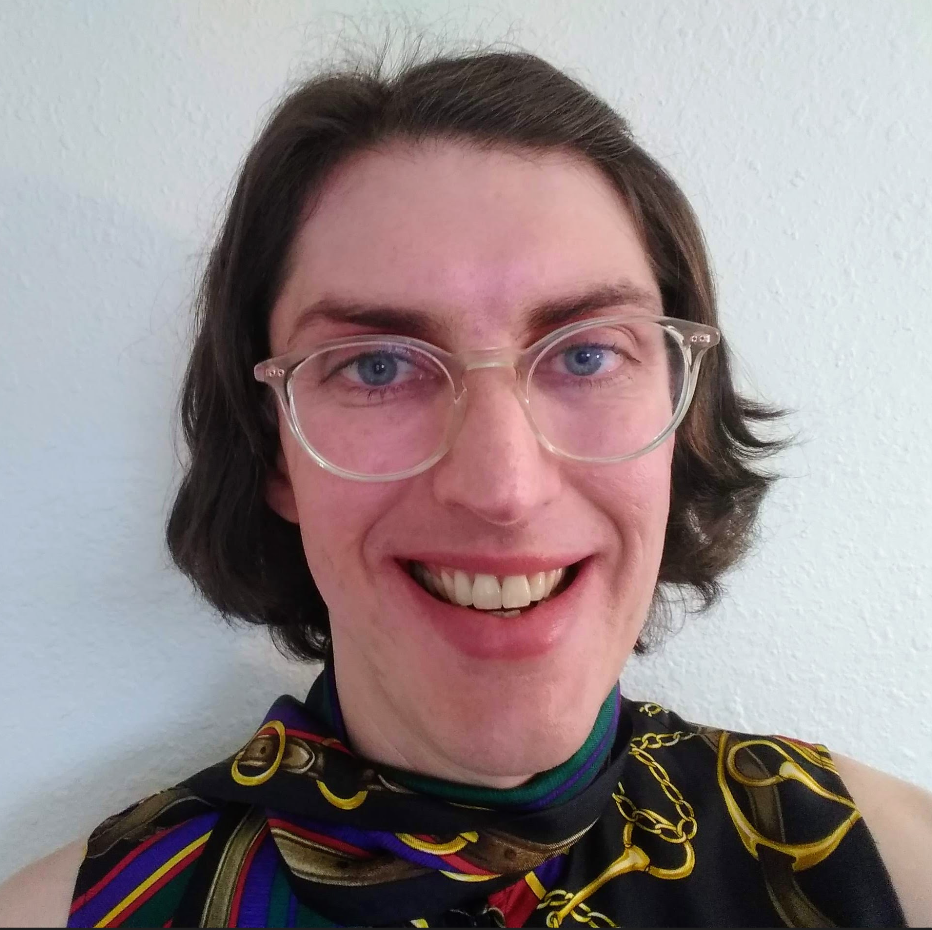
Biography: Mila Bea is a thirtysomething autistic trans woman who spent the last two decades on a tumultuous path to self-acceptance. While nestled indoors she drinks coffee, reads books, and watches movies. While out of doors she explores the world on foot, finding adventures in things novel and familiar. In her spare time, she often contemplates the processes by which people form beliefs and how this impacts public discourse. Find more of her writing at: https://medium.com/@mila.bea

Friday, March 26, 2021

Of The Disabled Equestrian: The Carriage Driver by Su Zi

Image: Bob Giles in his riding gear sitting on a black carriage. A white and brown horse is pulling him. The grass beneath is lush and the sky is a pure blue with trees lining the background. In front, on the bottom of the picture is a white fence with the letter "C" on it.

Horses are beautiful beings who have had their existence cast with us humans, and our civilization has been built because of their kindness in lending us their bodies, and their lives. For those of us whose bodies are atypical, it might seem to be an impossibility to meld our lives with that of a horse, but the growing programs for therapeutic equestrianism tell us, yes, it’s possible: there’s even a World Championship for Para Equestrians, with teams from many countries. Equestrianism in itself is a faceted art form, with practitioners in disciplines as varied as leaping fences and dancing in an arena, cross-country eventing to dressage to reining to carriage driving. The partnership with horses is as varied as the cultures of our Earth, because horses have been involved in human lives globally for long in our history.

Art is more than a painting in a museum. The Arts have a history and it involves real world craftsmanship, it involves all the methods of perception we have counted. The Arts also involve collaboration—Alexander Calder did not personally weld his monumental sculptures—and that craftsmanship too has a history. So it is with the horse: centuries of communication between them and us, and some of it about them to ourselves. As our culture may know ballet as art, or music as art, so too is our dance with horses an art. It’s also a physical art, because equestrianism is dancing and doing so with a partner who does not speak as we speak to each other. For those of us who speak differently, or move differently, whose strength is less than other humans, the interaction with horses opens a new view— their language, their physical beingness in our shared world.

Among equestrianism’s more exotic pursuits is the elevation of carriage driving—upon which our civilization was built—to a collaborative ballet between horse and human via the vehicle; a sight which is occasional in our culture, still with us thanks to Her and His Highnesses of England, and to the Hollywood western or occasional gladiator morality play. And thanks due to the interest of a then-young His Royal Highness, carriage driving has become an evolving sport. As para equestrianism in the saddle has evolved to include both world competitors and aide for veterans and autistic children, it behooves consideration of the art of carriage driving as well: there are those who have carriages that accept wheelchairs and who climb the logistical mountain of traveling with personal mobility aids and prosthetics, the horse and their food, equipment and special vehicles to a gathering of equestrians —the horse show.

Image: A red golf cart with a disability placard sits on the grass at sunset. 

Carriage Driving Horse Shows are specialized events, because some of the competitional elements require land— and land is ever the subject of contention among humans. It’s not as often that one sees a horse-drawn vehicle, and it’s to our loss and sometimes shame as a species. As humans consider their varying forms of existence, and as certain cultures of the globe consider social issues, and as we encounter these social issues under the mortal threat of Covid, our conversation must include disability. Carriage Driving does include disability, and even the Facebook group has over a thousand followers. There are Driving for the Disabled facilities established and more needed. “Horses are healing on so many different levels” says Boots Wright, a carriage driver of 35 years, who was “flung out of a carriage in 2008” and has had “several head injuries”. It is her red golf cart with the disability tag, and it is her international standing as an esteemed carriage driving equestrian that earned Wright the Chef D’Equip position at the 2012 World Equestrian event in Brade, Holland—and where USA ParaDriver Diane Kastema took home the gold for us.

There are associations for world equestrianism, the Federale Equestrian International, which is the governing body for that level of equestrian sport. In the United States, the American Driving Association both governs competition and seeks to include all carriage drivers of every level. To this end, Wright was involved when the ADS “events community was tasked with the creation of a program in 2017” that included Disability Dispensations, so that disabled equestrians could participate in their beloved pursuit.  

Wright fully acknowledges the art in carriage driving, and said in an in-person interview, that carriage driving is art, “because you’re not sitting on the horse, you are sitting behind it. You have two hands and only have hands, eyes, and voice [with which] to see and appreciate the horse’s body language. It can’t be taught by rote; the techniques can be taught, but the way you perceive things is in your own head.” As the artist brings the dream to the physical world, this is a physical display, a ballet, a performance of, as Wright says, “heightened senses”. Anyone who has experienced art can testify to the exhilaration of being engaged in the shared vision between artist and recipient. So too it is to see a horse swirling their beautiful bodies in concert with the hands that wisely guide. An interesting aspect to equestrianism is that the human in partnership with the horse, melds to the watching eye, becomes a centaur, a mythic being. Disabled drivers on the box can become elegance incarnate.

While indubitably every disabled person ought to have the choice of equine assisted therapy, not everyone wants to be an athlete; and while there is a para-equestrian riding team of serious athletes which has serious support, this is not as true among Disabled Competitive Carriage Drivers. Competitive Carriage Driving is itself a sport of mere thousands, with severe curtaining of travel and gathering, that events are happening at all with safety protocols is a testament of love.  The competitors are an open mix of professional equestrians and devoted amateurs, of backyard horse owners and of ones of deeper resources, and there is no distinction once the horse enters the arena at A. Although there are a few, specialized patterns for Disabled Drivers, Wright—who is a long-certified judge—says “I judge the horse not the driver [and that she doesn’t] classify or qualify a person’s disabilities”. It is the horse dancing with the human, abled or disabled, it is their performance together which is on stage.

Because of Covid’s many delays, the World Para Driving event has been rescheduled to this summer of 2021 in Shildau, Germany. Wright will be among the judges there. In the USA, there are fully capable disabled carriage drivers who are skilled enough, talented enough, dedicated enough to go as the team for America.  In the past, disabled veteran Bob Giles brought us home the silver medal, and the American team of disabled drivers have brought home bronze and gold too. Yet, this team is ever struggling for support that matches their own serious endeavor. Whilst the dark view of disability might view this as a social status quo, Covid is changing our culture and new conversations surround diversity. There are strenuous efforts to include disability in all diversity discussions, and this ought to be true for disabled athletes. As the horse equalizes us all as human, so too the horse does in carriage driving to those on the box. It’s just past time to give our support to the disabled, to disabled athletes, to disabled equestrian athletes and to both carriage driving, disabled carriage drivers and the extraordinary endeavor these athletes have made to perform as our team on the world stage.

Notes: 

Photographs taken at Grand Oaks CDE in January 2021. They are taken from a judge's viewpoint. 

The 2021 FEI World Championships for Singles Para Driving will take place Thursday, the 5th of August through Sunday, the 8th in Germany.
~*~
Su Zi is a poet/writer and artist/printmaker and edits, designs and constructs the eco-feminist poetry chapbook series Red Mare
Publications include poetry, essays, stories and reviews that date back to pre-cyber publishing, including when Exquisite Corpse was a vertical print publication, and a few editions of New American Writing. More recent publications include Red FezAlien Buddha and Thrice. A resident of the Ocala National Forest, with a dedicated commitment to providing a safe feeding respite for wild birds, and for a haphazard gardening practice that serves as a life model for all aspects of her work.

Friday, November 27, 2020

Card Making with Spazzy Crafter

Today, I will be talking about some of the different types of cards I have made. Also, some of the supplies I find that work (for me) the best.

Card kits

I like these because most of the supplies that you need are included... even an unfinished card. Most of them come with double-sided sticky squares (one side sticks to the card, and the other side sticks to the embellishment). Sometimes, there are embellishments that have a sticky back to them so you just peel off the paper. One of the best things about these kits is that they come with instructions so you can see an approximation of what the card will look like when it’s done, but you don’t always have to follow exactly. It’s your choice, so it becomes your design.

Now, one thing I don’t like is that the kits don’t come with glue, and you need that to put the first layer on the card. So I use glue sticks instead of glue from the bottle because it’s easier for me to hold a glue stick than a bottle of glue.

Image: A cream and gold card with ornaments topped with red bows. Near the bottom of the card is a tag that says "Merry Christmas".

Freehand cards

Some of the supplies that work well for my freehand card creations are ink stamps and gel pens. Decorative punches don't work well for me because of the force required to operate them. I have yet to experiment with stencils.

Other types of cards

Diamond paintings kits include: Plastic diamonds which are little rhinestone-type beads, pink wax that you use to pick up the diamonds, and an unfinished card.

Image: On a blue background with white-dot snow, is a reindeer bust with blue eyes. He's wearing a Santa hat with decorations on his antlers and a red and white striped scarf on his neck. His nose is red. Below him in large, red capital letters is "Merry Christmas" with an exclamation mark on the end. 

In my next post, I will be reviewing The Cricut. I use it for making cards, and it can aid in other crafting projects as well.

Image: A light pink card with dark foil cut-outs. The central image is a silhouette of a cat with bats above its head. The corners of the card are also the foil. At the top of the card is a foil crescent moon with the words "trick or treat" in thin, black capital letters.

Does anyone else know of any other types of card-making supplies or techniques I should try?

Friday, October 9, 2020

The Blind and Art by Carol Farnsworth

I have enjoyed seeing art exhibits. As my sight has decreased, I have learned to rely on verbal and braille descriptions of the displays. I still long to touch the art with my fingertips.

I was able to do this in Death Valley at a place named ”Scottie’s Castle”. It was a large home built in the early 1900’s. It contains many decorative carvings in the woodwork and brass knobs. The carvings are in the shape of the animals and cacti found in the area.

The docent was delighted to have a visually-impaired person in his group. He put on a glove and guided my fingers to touch all the carvings and the brass bird heads that were the faucets. He told the rest of the group that they could not touch anything. He and I explored all the surfaces. I was embarrassed and delighted to get a tactile and audio tour.
~
My husband and I are members of a sculpture park, and I take delight in touching the art in a garden setting. The docents watch but don’t stop me from lightly touching the art. I have even sat on one art bench to get the dimensions of the piece. The docents are there to prevent small children from climbing. They understand this touching is how I experience the art.
~
My local city sponsors a large art show each fall. I was worried if I would have to be content with descriptions of the art pieces. When we got to the outside pieces, I was able to touch parts of the large ones. Some pieces had signs inviting the public to touch.

If the artist was near his or her piece of art and they listened to the art being described to me, they would ask if I would like to touch the piece. They would point out parts of the art they were most proud of.

One woman, after finding out that I was a knitter, placed my fingertips on a carving of a men’s sweater and asked if I could feel the dropped stitch in the pattern of the sweater. I told her I could.

If the art was not able to be touched, the artist put a display of the art pieces for people to feel. This was done in a piece that was 
covered with three-dimensional flowers. She had several flowers in front of the picture to touch.

Another artist allowed me to feel the muscles in a group of running horses.
~
I have not found a way to tactilely enjoy paintings. I know that the 
art may be hurt with touch. I did find a group of paintings that had sand and other mediums mixed in with the paint. The art was tactile and I could discern parts of the art by touch.

Including the blind when setting up an art exhibit takes some time, but it is well worth the effort.

I continue to support the arts and making them accessible to all.
~*~
Biography (in first person):  I was born with glaucoma but have become totally blind in the last four years. I have a teaching degree in regular and special education and a Master’s degree in Speech Pathology. I worked with mentally disabled adults (many were nonverbal). I learned to use many techniques to elicit communication.

Similarly, I will use many tools to deal with blindness. I will use braille, voice over, and Seri to assist me with writing.

Other interests include gardening, listening to audio books, and riding a tandem bike, which my husband John and I have been doing for 22 years.

Thursday, September 24, 2020

Musings From a Spazzy Crafter

Is a craft still my own when I feel like I am an assistant? I struggle with this question often.

I am working on a friendship bracelet and someone is working with me on it because I have trouble tying knots. The person makes the knot and I pull it tight. Is that my creation?

Does it matter how much help is needed? Does it matter the type of
help that is needed? If I string beads for bracelets but need help finishing the bracelets, can I still claim them as mine?

How do I show appreciation for people that help me create?

These are some of the questions that go through my head.

Do you struggle with these questions while you're crafting?

Musing and making,

Spazzy Crafter

P.S. The next post will be about card making.

~*~
Jennifer's Thoughts:  Personally, I think it depends on a few factors. If you need significant help on a type of project and are doing it as a business, giving your helper a share in the profits might be the way to go. If you're making something just for a gift, perhaps thanking them is all you need. Always work out what is expected beforehand. 

Little things like having someone tie a knot doesn't invalidate your ownership of the creation. You could consider the amount of time it takes for someone to help you, or how much of the project you need assistance with to determine if what you're working on is a collaboration. That's the thing: Even if you both put in equal amounts of effort, you are collaborating with someone to make something gorgeous and are not an assistant. It doesn't mean you're less of an artist (the design was still your idea, and you're providing labor and materials). It just means what you give to the person helping you depends on their amount of labor.


Friday, July 31, 2020

Spazzy Crafter Introduces Herself

I have spastic cerebral palsy which affects the left side of my body. I love to craft, so finding ways to adapt or adjust how I make crafts has been an interesting experience.

I have become a serious crafter in the last decade.

Crafts I am able to do with adaptation or assistance:
  • Card making
  • Diamond Dotz (Diamond Paintings)
  • Plastic canvas
  • Friendship bracelets
  • Ceramic painting
  • Loom knitting
  • Stamped cross stitch
  • Needlepoint
  • Beadwork (earrings/necklaces/bracelets)
In upcoming posts, I will be discussing each of these crafts, how I adapt them, and other adjacent topics. I will also be discussing crafts that I am not able do along with those I would like to try.

Does anyone have any crafting recommendations?

Yours truly,

Spazzy crafter

Friday, April 3, 2020

Crisis by Louise Runyon

I have been thinking of it as a situation, because it’s come about so slowly.  But in reality, it’s a crisis.  A crisis of the body/mind, a movement crisis.  A crisis of movement, ironically developing as I prepared to move from one state to another.  And continuing after the move, as I find my way here.

This crisis, or situation, has to do with walking, with standing, with standing up.  It has to do with manipulating fabric, making the bed, shaking out a plastic bag.  With dancing, with swimming, with biking.  With cooking, handwriting, typing.  With rolling over in bed, getting dressed.

It is more than just aging.  It’s neurological, but it’s not neurological.  It’s mysterious, vague, hard to talk about, has no name.  I haven’t liked to talk about it; have feared gossip; have tried to hide; have had embarrassment, shame.

Embarrassment and shame because I am a dancer and a practitioner of a stellar method of movement education.  This method, like my malady, is profound but obscure, hard to describe.  Given my background, I am not supposed to be this way.  No one has expected it, least of all me.  I am supposed to live to be 103, just like my mother.  I am supposed to live better than she did, because I take so much better care of myself.

I have moved elegantly, eloquently, for decadesbut not now.  It’s been surprising, sudden, slow.  I should be full of vim and vigor, but I’m not.  I’ve done everything I could, everything I know, and I know a lot.  I’m disciplined.  I make certain breakthroughsstill, it persists.  It is even more persistent than I am.

A few things I’ve maintained.  BalanceI know how to fall, but I do not.  I’ve maintained walking, even some hiking.  My calves grow solid from climbing the hills.  I have no comfort, but I have no pain.  Sometimes I pass for normal, but less often.

Some things helpplaying catch, kicking a soccer ball.  Talking to people.  Music, finding a way to dance.  The solid, assertive contact of boxing.  The unglamorous activity of resting.  Friends, old and new; family.

~*~
Louise Runyon has recently been diagnosed with environmental toxicity, which affects involuntary movement and requires conscious motor planning for most things she does. Louise has published four books of poetry; her last book, released in 2018, is The Passion of Older Women – a manifesto on the wisdom, strength, needs and desires of older women as well as a testament to those who have gone before. A dancer/choreographer as well as poet, Louise is Artistic Director of Louise Runyon Performance Company. She is currently based in the mountains of North Carolina.  www.LouiseRunyonPerformance.com

Friday, March 20, 2020

The Inheritance by Su Zi

Gramma carried mint candy in her handbag, along with a linen handkerchief with a hand needled lace edge that she carried without using ever. Other talismans were a tube of deep red lipstick and a crumpled paper tissue. The handbag was a top strap, traditional shape with a snap close of brass, and was completely different than the soft, shoulder slung bags my mother favored. My mother did not carry mint candy, she carried mint gum. When I became old enough to need a handbag of my own, I had neither; however, by then I understood that the contents of a handbag were distinctive, individual. It was a long time before I understood why these significant women in my ancestry were always accompanied by mints.

After I had access to a car, I would visit Gramma on my own. We would sit in her kitchen and she would tell me of her life: of our shared ancestors, of how she came to this country, of her marriage to my beloved grandfather. One time, she asked me a series of questions about my eating habits—did I like to eat breakfast, what meal was my largest, why was I so skinny “you are a little bird” she told me forever. As a preteen girl, she had lived alone with her father (she wanted me to know his name was Shopkin), and Gramma felt that my eating habits were just like his: she told me I had “A sensitive stomach”.

My propensity for intestinal malaise was well documented among those who orbited my childhood consciousness. I was told I had been a colicky baby who wept for months; when my mother decided to experiment by feeding us McDonald’s, I had painful hours hanging my hind end over the commode; then, at 18, I had a bout of not being able to tolerate food…at all. I was sent to a doctor, who handed me a script for Lomotil—I was not to eat for a month, except a poached egg, or overboiled noodles. I had further bouts of food intolerance, but I did not go to a doctor again. A sleepless night, a significant exam, meant an hour in a pain filled Thinker position, and a queasy public bus ride to class. I began to photograph the private corners that housed my agonies—gas stations, restaurants, home: I had gotten used to chronic diarrhea without thinking about it, it just was part of who I was, just as not being tall was part of who I was.

My mother laughed about it. As a child, there was always a big bottle of Pepto Bismol that never saw lack of use. When I bought my mother concert tickets for her birthday, we went to dinner afterwards, and the very posh Ladies’ room immediately after dinner. I sat in one stall, my mother next to me, and while we both let the burning mud escape us, my mother laughed and laughed.

Over a few decades, such episodes of sudden incapacitation grew ordinary; my economics always made the acquisition of food, any food, more of a concern than whether or not it would tear me up. My constant emaciation was met socially with offers of drugs or dick; I was unaware I was starving.

One Thanksgiving, I had been invited to dinner and arrived to find the kitchen full of young women I did not know. I ate their offerings, they liked my homemade cranberry sauce. They were concerned when I retired to the bathroom for the better part of an hour: I remember repeated attempts to force the door, and also the fever sweat dripping to the tile and bleaching away circles of ground-in sand; the paroxysms had my elbows around my knees, and pain was an incoming tide of electric shocks and burning. Eventually, I made the drive home; yet every time I ate was another episode of agony. Weeks went by. I was in a new town, knew no one, went to job interviews as I lost weight, lost weight until I could barely make it ten feet from my couch to my kitchen without a head rush that had me swooning in front of the concerned cats. That one took two months from me.

Life unfolded as it does when you don’t die young. Eventually, two women stood in my yard and welcomed me to the woman change, bestowed upon me the title of Crone, though it was still decades away from the number the government gave. I was still thin, but the changes to my body included more episodes of lost time with increasing severity.

A few summers ago, I once again lost the ability to tolerate any food. I struggled for a month to find something that wouldn’t bring forth the fits of endless shitting, until I was keeping myself alive with only miso soup. One Sunday, I had been invited to go for a pleasure cruise in a classic car and we stopped at the farm-to-table pizza-salad place. I nursed a cigarette and a fancy root beer. Everything began to echo, and my vision became a vignette of darkness and shooting stars. My forehead was on my knees, my dress was damp, an elbow helped me rise, there was a man on either side of me, and then…. I felt myself lying down, I felt a hand on my ass—perhaps my dress had flown up—I felt how the ambulance needed new shocks and how the tech kept my palm on her knee, how the driver called in my vitals with a sugar level of 30.

It has been a learning, albeit late, of language, although I am still infuriated: I rage against the lost time, the social media posts of foods that I know will kill me have become a kind of pornography. I had one friend who endured what I did, he would lift his shirt to show the scars of multiple surgeries and the cane he needed for resultant tremors; just this past holiday, he died—the last photos of him show a ginger skeleton. It was he who used the word the doctor had: Crohn’s. We had Crohn’s. It had gotten worse as we had gotten older, and so my Crone status was also my Crohn’s status.

In social situations, I make people nervous—there are shunnings. I have been known to steadily eat two dozen sugar cubes while performing other tasks; I have been known to blithely eat as many mint candies. A free lunch is a cocola and a plain chocolate bar. I weigh myself daily, trying to stay more than the 88 pounds that resulted in a public view of my panties.

I do not carry mint candy or gum in my handbag, but I know now why the women who came before me always did.
~*~
Su Zi is a poet/writer and artist/printmaker and edits, designs and constructs the eco-feminist poetry chapbook series Red Mare
Publications include poetry, essays, stories and reviews that date back to pre-cyber publishing, including when Exquisite Corpse was a vertical print publication, and a few editions of New American Writing. More recent publications include Red Fez, Alien Buddha and Thrice. A resident of the Ocala National Forest, with a dedicated commitment to providing a safe feeding respite for wild birds, and for a haphazard gardening practice that serves as a life model for all aspects of her work.

Friday, August 30, 2019

White Cane Evolution by Carol Farnsworth

1.
We have a love\hate relationship with our white canes.  When first given a cane to use, we reject it.  Usually, we get into a situation where we find that is better to use the cane.

My incident came at a fast food restaurant.  I was eating lunch with my family.  During the meal, I got up to use the restroom.  I bumped into several tables on the way to the wall where I felt my way to the restroom.  I repeated the feeling and table-bumping until I was back at my own table.  When we were ready to leave, I unfurled my folding cane with several loud clicks.  As we were exiting the restaurant, I heard one of the employees remark,"I thought she was drunk!"  To be seen as drunk or blind, I would rather be blind.

2.
Eventually, my orientation and mobility instructor convinced me that I would be safer with the white cane.  I was a novice working the cane.  When with my sighted guide, I would hold the cane in a defensive position.  If I became nervous, I would swing the cane wildly in front of us, people would part like the Red Sea in front of Moses.  I believe that they were worried about being struck by my wild antics with the cane.

With time, I learned the two techniques of bouncing the end from side-to-side or dragging the end of the cane from right to left.  Both cane movements were coordinated with walking.

3.
When we traveled to Scotland, I had good cane use but the novelty of a white cane user convinced the pedestrians to give us a wide berth, some people were so intent to get out of our way they jumped into doorways or off the curb.

As I gained confidence and training in cane use I never left home without it.  Even with a sighted guide, I still hold my white cane at the ready.

When walking with my daughter, I was using my cane and talking to her. Unknown to me, she veered us directly towards four young men walking in a line. She stopped the end man and asked,”Don’t you see this lady is blind? She will not get out of your way!”. He mumbled a “Sorry?”. I quizzed her about the incident and she replied that they needed a lesson about others in their environment.

4.
I have made peace with using my white cane and never leave home without one. People still want to help me cross streets or grab my elbow to propel me forward because they see the white cane, not me. With patience, I explain what I can and can not do. By interacting, I help people see the person behind the cane.
~*~
Biography (in first person):  I was born with glaucoma but have become totally blind in the last four years. I have a teaching degree in regular and special education and a Master’s degree in Speech Pathology. I worked with mentally disabled adults (many were nonverbal). I learned to use many techniques to elicit communication.

Similarly, I will use many tools to deal with blindness. I will use braille, voice over, and Seri to assist me with writing.

Other interests include gardening, listening to audio books, and riding a tandem bike, which my husband John and I have been doing for 22 years.

Friday, December 21, 2018

Go Figure: A Meditation on Illness and Understanding by Dov Zeller

I.
Latin figurare "to form, shape.”

The inscrutable shape of a story unfolds here.

Not a story, a catalogue of thoughts. A scrolling form.

The beautiful chaos of musings. Another misshapen day.

What will I do with these flocks? Seconds that make up minutes—sunlight glinting on their wings, where comes together so many feathery hours.

Hours like a pod of whales that swims in formation (fully aware that the toxic waters won’t hold them much longer). And what do they do? Do they nod a little goodbye to the world? Sink to the sand below and be done with it? No!

They love and mourn. Swim in community and flex their muscles. Fly up into the air and make art. They are activists, and they play, because they know these hours are all we have.

(Hours that make up days.)

Do days cut a poor figure? Are they to be held and trusted, or let go? Followed quietly? Flushed with everything else into the oceans of time that so long ago held and worried and groomed us until we walked or crawled or shimmied out, sunbathing on the banks.

I don’t know. I’m figuring (it figures)… I’m figuring something… I’m figuring (nothing) out.

All days have shape. Just different. Differently-shaped days. My days won’t fit. They won’t rest on the kitchen table or sit idly on the palm of my hand. The briefcase can’t close over them. Like water they spill over and through and soon, there comes another.

And there you have it, a week. Seven days, an odd, prime number. In a month there are four of them, and usually a few extra days thrown in for good measure. Like a pinch of salt. The flour left on the cutting board after the dough is rolled. (There is (dis)order in (dis)order.)

As for me? A bit crumpled lying here in my bed. The sheets in a tangle. Someone somewhere will say, “He cuts a poor figure.” Don’t worry. We’ll figure it out. We always do. (Time and I until time goes on without me.)

II.
I’ve heard some say “I don’t have a musical bone in my body.” Others that they don’t “have a head for figures.”

But the truth is, music is simply part of the landscape. Within and without. Birds sing almost everywhere. Crickets salt the night. Wolves go on and howl. Fish swim and dart in great symphonies, bless their shoals. The sun rises and sets, the moon in its cyclical shadow. Tides go in and out. Our hearts beat at a rhythm and our blood hums along and so there is at least one music to be escaped at great peril. (Use the musical sign for rest.)

As for figures, those of us who see a line, a circle, one or two disconnected strokes, begin to find a body forming there. Our brains are trained to connect. To see faces—the Virgin Mary in a piece of toast. An electrical socket, two eyes and a nose (or is it a mouth?)

Pareidolia is the word for people who see faces to excess in inanimate matter. But it’s all a matter of degree. To see identifying characteristics everywhere. To form a face, a body, a story.

We nearly all have a head for figures to a point.

And then there are connections that go beyond the immediate. Yesterday x talked of a friend. “They’re brilliant,” x said. “They read a lot and watch a lot of films and make adventurous connections.”

(Adventurous connections!)

(When we seek connections that haven’t been made for us, that we haven’t been made for, then perhaps we are hang-gliding for understanding. Spelunking for truth.)

Some people are imprisoned by false connections, marinate in them until all they can do is force dots and lines together from two different universes to insist on a truth that isn’t there.

I am trying to have compassion. Trying to understand. The universe is bigger than a bread box, and yet, someone somewhere might hold a whole universe in their hand.

III.
Definition. Figure. The “visible and tangible form of anything.”

Etymologically, the word comes from the formation of numbers. Lines building themselves into symbols. From there the word goes more broadly figurative. And then, more literally figurative? Lines forming a self. A body. (Here the line between literal and figurative begins to swerve.)

Realistic figures. Abstract figures. Classical figures. Figures in shadows. Figures in light. Hidden figures. (Is there space for realism when all is processed through the work of memory? Perhaps we live largely in fable, in rigorous dreams.)

To create a figure, you may first need a line. (I’m casting it. Hold on. I’ll reel you in. But what if the line is dotted?)

So often I’ve heard reverence declared for an artist’s curved or voluptuous, continuous or disconnected lines. When I try to form a line, it staggers, drunken, across the page. It jitters and shivers and refuses to listen to the idea that brought me to it.

I look at abstract art and even when I admire the lines, I don’t know how to speak of them.

“Which paintings have sharp lines, and which are soft, smooth or rough? Do the lines in the composition draw your eye to a specific part of the painting? Do some lines contribute to the feeling of action or stillness in the painting? Does […] always use the same style of linework, or does [their] style vary?” (“Five Ways to Think About A Line” click here to read.)

I look at my abstract life, and wonder, where is the specificity here? Where are the days? They’re all a mash. Vegetables boiled until the flavor’s gone out and you don’t even need a mill to turn them to soup.

And yet the next one comes folded and new. Fresh as cut grass. Sharp as a wound. Vivid and full of wonders because we live on a great marble that spins around a moving ball of fire. Interminable explosions freckle the sky as far as the eye can see. How can I not feel awe?

(When theories of light were young, philosophers thought the eyes reached out to grab at light, rather than being open and sensitive to the light that travels toward us.)

I’m so sensitive to light, I lie in the dark for most of my waking hours. I’m light averse, but most stars are far enough away that they don’t hurt. I’ve hurt people I love and all I can do is try to accept, to acknowledge, try to let go and do better as new days travel toward me.

Sometimes the past feels as far away as the unheated light of distant cosmic objects. Other days, time feels so airless, each day of my life a transparency set atop the next until light can’t get through and everything is inscrutable, but the pain of the past is as young as it ever was.

Still, I am trying to figure out what it means to be a figure in bed. A still life while still living. Not portraiture. Neither captured on canvas like fruit or a vase of flowers. No “Starry Night” (Van Gogh) or (Soutine) “Landscape in Ceret” (still lifes in motion). Just lying here unable to feel the constant motion, the Earth barrels along at nearly twenty miles per second and I sit here in the dark (what kind of figure am I?) listening to the rain.
~*~
Biography:  Before getting full-blown CFS/ME, Dov Zeller struggled to sit still and often read while walking (in between swimming, biking, and yoga). Now he is an intrepid recliner. Though sick with a devastating chronic illness, he is determined to appreciate the ecosystems he comes into contact with. As it turns out, even a small world is full of endless complexity. He enjoys reading, writing, visiting with friends, listening to audiobooks and classical guitar, and observing birds who drop by the window feeder. Zeller lives in Western Massachusetts, where he moved in order to complete an MFA in fiction at UMass Amherst. He has also lived in San Francisco and Oakland, California, and Brooklyn, NY, and he grew up in eastern Pennsylvania. He has two novels coming out this year.

Friday, December 14, 2018

Ezekiel Saw the Wheel by Rosemary Woodel

Ezekiel saw that wheel
Way up in the middle of the air
Ezekiel saw that wheel whirling
Way up in the middle of the air
Now the little wheel runs by faith
And the big wheel runs by the grace of God
And a wheel in a wheel whirling
Way up in the middle of the air
-Woody Guthrie

I’d been having trouble with visual acuity recently.  More trouble, is the truth of it.  It isn’t carelessness that causes me to take photographs that aren’t sharp.  “Tack sharp” as my photography teacher says.

July 19 and August 2 I saw Dr. I., the retinal ophthalmologist.  Normally I see him every three months.  I’d gone back again so soon because I had a new symptom I wanted him to check.   
I’d been in the hospital in late July for three days with a hemiplegic migraine.  Slightly before then and after, I noticed a wheel whirling in the middle of my field of vision in the left eye.   It was like a wheel spinning while the car is jacked up in the garage — it revolves but goes nowhere. 

 Dr. I. looked at his fancy photographs of the back of my eye and saw no change compared to previous photographs.  He therefore thought the wheel was the aura of an atypical migraine.  Not being a doctor, I didn’t disagree except in my head, because it was unlike any aura I’d ever had.  
 
 My migraine auras are active — bright and flashy and careening all over the dance floor of both eyes.  This shiny rotating disc was only in my left eye and remained straight in my field of vision.   As a photographer, it bothered me greatly that I couldn’t take a picture of it.

Meantime, my vision overall was causing problems in taking and processing sharp photographs.   (I was already used to not reading the printed page well.)  On August 20 Dr. D., my regular eye doctor, said both corneas were engaged in map-dot-fingerprint dystrophy.  It took me two weeks to memorize that.  Wrinkled corneas meant that seeing things in focus would be a challenge.  He said that down the road “they” could scrape them or iron them or somehow smooth them out but there was a long recovery time.  Meantime, I should put drops in my eye every hour.

But back to Ezekiel’s wheel.  Maybe I was better able to describe what I was seeing to Dr. D. than I had with the retinal guy because Dr. D. thought it was not an atypical migraine and suggested I see Dr. I. again, which I did in short order.  

For the first time since February 2017, my wet macular degeneration was active again.  This showed up in fancy photographs of my retina, not from my complaints about Ezekiel’s wheel.  
 
“So,” said Dr. I., “Your shiny wheel was a warning of things to come because this bleeding area was definitely not there earlier in the month.  It’s good Dr. D. urged you to return here.”  And so I had an injection in my eye.

Now the little wheel runs by faith
And the big wheel runs by the grace of God
And a wheel in a wheel whirling
Way up in the middle of the air

Soon after the injection, I saw black floaters that look like many flies in the dining room.  Wait, one of those four is a fly!  Now they’ve turned into crows.  I miss the little wheel, but all these creatures are entertaining.  

I will be changing the subject matter of what I photograph.  If I can no longer do macro photos of flowers, I can experiment with other subject matter.  A few days ago I took photos of shadows of sculptures at the UGA Museum of Art.  If they are a bit blurry, it doesn’t seem to matter so much.

Having had significant losses in my life, I make it a practice to encourage a Plan B.  Or a Dream B.  If I can’t do what I am accustomed to doing with my eyes and brain, what can I do with whatever still works?  A friend says this approach — resilience — is one of my strengths.  Oddly, I’ve noticed my photography is becoming more artistic as I experiment.  That is a very good thing.
~*~
Biography:  Rosemary Woodel is a photographer with diminishing vision and a writer with Traumatic Brain Injury (TBI).  At age 77, she is still adjusting to life in what she hopes are creative ways.

Friday, December 7, 2018

Viewing Frida Kahlo by Emily Rapp Black

CW:  Miscarriage

London (2018)

They come out in droves to see her in London: school groups in their crisp uniforms, sharing bags of sweet and salty snacks and looking bored; sunburned German tourists, one wearing a plastic mask of Donald Trump’s face; a woman in a black burka and black sneakers hurrying toward the museum steps. I’m nervous going in, although I know what to expect: Frida’s legs and casts; the corsets that held up the bones of her back; some of her best and most photographed articles of clothing that make up her quintessential “look.”

The Victoria and Albert Museum is in South Kensington, an area of London where apartments cost in the millions of pounds, and the white buildings are so spotless in the late September sunshine that I’m reminded of the white buildings in Mojacar, Spain, where my friend Emily and I strolled around on a hot summer day six years before when my son Ronan was still alive, my daughter Charlie was not yet born, and I hadn’t yet met my husband Kent. My friend spent the entire day talking me out of a manic state, my first and only (and I hope the last). Later, after hours of walking, we smoked cigarettes and drank white wine on the beach while she rubbed aloe on my sunburned back and I cried. I loop my arm with hers now.

“I had no idea Frida was so popular,” I say, and I’m legitimately surprised. “I’ll bet half of these people didn’t know she was an amputee.”

“You’ve dressed like her,” Em says. It’s warm in the first exhibit hall, and we jostle against the other onlookers, all trying to get close to each photograph or painting or fragment of a framed, handwritten letter for a few long seconds.

Indeed, I have deliberately dressed like Frida, or perhaps in homage to her. It would be ridiculous for an American woman to wear a Tehuana dress, but I have disguised myself in my way, one of several forms of controlled presentation: a denim vintage dress (always vintage, the fabric holding someone else’s story that will never be known to me) with a ruffle on the bottom hem and a nipped waist; tights; mid-calf 80s dead stock white go-go boots; gold jewelry draped and layered around the neck and across the chest, understated elsewhere; dark lipstick; a single braid.

“This is my confident get-up,” I respond.

“It’s working,” she says, and smiles. My mother, 75, and my daughter, four, walk ahead of us, my mom trying to shush Charlie as she cries loudly, “I want to sit down. This is so boring. I don’t like this room.” My mom picks her up and begins strolling around with her, whispering in her ear. She giggles. I wonder what my Mom is saying to her.

The rooms are heaving with people, and Emily and I quickly separate. I’m starting to feel hot and awkward, as I often do in art museums, when the pace of viewing is so slow and people are thinking so hard it’s as if they create their own kind of heat. It’s a miracle that more people don’t faint. Walking slowly is the hardest kind of movement for me, and without the momentum of follow through that happens at a quicker clip, I limp noticeably, which makes me feel unmoored from my body. And that makes me nervous. I notice people’s stares; people are staring. I feel their eyes on me as I limp, then on the photographs of Frida. A hushed concentration hangs in the room - a palpable sense of people looking at things to try and understand them, or memorize them, or take them in.

I’m feeling impatient to see the legs and the corsets and the boots. That’s more my genre. I move into the second hall, but it’s so packed that I’m forced over to the left side, where I stumble into the man in front of me, who catches me as we exchange awkward apologies. When he steps away to reveal a photograph of Frida I’ve never seen, I feel like someone has power punched me in the chest. I literally think of the heavy bag I used to have in the back room of my house in New Mexico, and all the hours I spent beating the shit out of it. I feel like the bag.

I look around for Em - I don't want to stand alone in front of this photograph on the edge of tears – but I don’t see her. Charlie is sitting on the lap of one of the guards while my embarrassed mother tries to pry my jet-lagged, stubborn little girl from his arms. “I'm resting,” Charlie announces, but finally relents and sits next to him on the floor. “I’m just Charlie,” she tells the guard, who is smiling, and my mom, giving up, sits down next to her on the floor. She gives me a little wave.

She’s in traction, I mouth to my mother, but she can’t lip read that far away.

What? I see her whisper back, her eyebrows raised.

“Traction,” I say loudly, and a few people turn to look at me. My mom shrugs and shakes her head, clearly still confused.

Indeed, Frida is in traction in the photo, which is taken from the side, so you can see that her head is suspended in air, held up and back by the pulley system behind her, the canvas taut against her forehead. Her amputated leg is raised up in a white cast and her hair is long and dark and flowing over the white cotton hospital gown. First, I am flooded with the memory of how it feels to be held like that, in suspense, literally, and how painful and awkward it is. The ache in the neck muscles. The blood from the amputated leg rushing down, that feeling that someone is trying to push knowledge into your head through the bone of your forehead with the bone of their hand. How slowly sweat moves through canvas burlap.

Frida is painting. There’s a sketchpad in her lap, and a brush in her hand. This is what makes me want to weep. She makes as pain unmakes her. And she has just lost her leg. I am overcome with compassion for her – not pity – and also compassion for myself, which is hard to come by. To my right, encased in glass, are the corsets that propped up the bones in her back after the accident, and for the rest of her life. My own early casts and back braces were made of the same rough cotton material that stained easily and that looked like something you’d buy at the rope and saddle store.  Frida’s amputation was in 1953; mine was in 1978.  I don’t remember the braces in the Casa Azul; I don't remember the straps hanging from their shells were the same straps I remember pissing on, tying on, shitting on, washing in the sink with bleach, carefully scrubbing out the coins of blood from my period.

I hear a conversation behind me:

It’s so sad, so tragic. 

Isn’t it just terrible, the pain she was in?  

Oh, these awful…devices. But it inspired her to paint. 

Yes, it made her an artist. All the pain.

Mmmmmm.

I limp away, desperate to yell at these two middle-aged women who are having a lovely afternoon at the special exhibit at the V&A. I don’t. But they’re wrong.

Critics and fans, and just the average person who knows Frida from a tote bag or a refrigerator magnet, has inherited this narrative that pain was her muse. It’s what inspired her to paint, this narrative preaches, whether it was the wreckage of her love affair with Diego, or her chronic and constant pain, or losing part of a leg. Art has been codified as her ‘therapy.’” It’s so ridiculous I want to cry or scream, something. Instead, I keep walking.

Going half-made in Spain was not about being visited by a muse; it was a visitation by madness. Screaming out the window of a farmhouse, afraid to kill random bugs on the windowsill as the spirit of my dying boy might be trapped inside. Pretending to be Kafka, then pretending to be his lover, then pretending to sleep, then wanting to be dead. Wandering along dusty streets, my uneven footsteps lit by the bright moon breaking through, every so often, of the muted haze of a late summer Spanish sky.

Other art historians have broken Frida’s paintings into categories of those representing real pain and imagined pain. There is no way to calculate what represents more pain: the red leg with its winged painted foot in the glass, or Frida’s neck suspended in air. Which of her 30 medical procedures was the most difficult? Which of her four failed pregnancies hit her the hardest? Yes, she painted in bed. Create or die. That’s very different from “being inspired.”

Oh, those critics who make the architectural column of her spine a phallic symbol, who imagine the “penetrating thrust” of the pole through her pelvis and she must never have enjoyed sex. The pole got there first and she was ruined, crippled goods. They haven’t seen her legs, her winged feet, her corset decorated and shining. This wasn’t the art of inspired sentiment. It is the art of survival. But only if you see it that way. Otherwise, it all devolves into the typical narrative: the brave, pathetic woman who never had children, whose body was crippled, whose life was ruined.

Some critics and art historians have accused Frida of paying too much attention to her illnesses; some have debated the veracity of her pain, as if they were the architects of the scale. She was accused of allowing her illnesses to displace her maternal drive, and it was a fault, not a triumph, that she gave herself over to the masculine ambition of being a painter.

A diseased woman is a suspicious woman. A grieving mother is a suspicious mother unless she is a virgin and consecrated into the realm of religions impossibility.  It’s as if the idea – and especially the image – of a disabled woman in the world floats. It is there; no, it’s there; and there, or maybe there.

Another wall of portraits I hadn’t seen before: Frida naked from the waist up. Three black and white stills of her gazing at the camera while holding alternatively a mirror, a brush, an adornment for her hair. Her breasts are small and spherical and soft-looking. Her shoulders look sculpted and strong below the angle of her jawline. Wow, I hear someone say behind me, so close to me it’s as if they’re whispering in my ear. She’s actually beautiful. I never thought of her as beautiful. His wife pulls him along and the same pair of ladies stands next to me again. Such a pity she never had children. They would have been beautiful. And now I let tears blur my vision until people move past me and I hear Charlie saying, “Mommy! I’m so bored and I want to eat a cookie at the coffee store.” I pick her up and give her tired face a kiss. Behind us, encased in glass, the corset Frida cut a round hole inside as a way to show her miscarriages, to wear the losses against her, with her, around her, just as any mother would do.
~*~

Biography:  Emily Rapp Black is the author of Poster Child: A Memoir; The Still Point of the Turning World, which was a New York Times bestseller and a finalist for the PEN USA Award; Sanctuary, forthcoming from Random House in 2020; and Cartography for Cripples, forthcoming from the New York Review of Books in 2020. A former Fulbright scholar, Guggenheim Fellow, and James Michener Fellow in fiction and poetry at UT-Austin, she is the recipient of the Rona Jaffe Writers Award; the Winter Fellowship at the Fine Arts Work Center; the Wachtmeister Award in Nonfiction; and fellowships at Yaddo, Jentel, and Fundacion Valparaiso in Spain. Her work has appeared in Vogue; O, the Oprah Magazine; Redbook; the Sun; The New York Times; The Boston Globe; The Los Angeles Times, and in many other publications and anthologies, including The Best Creative Nonfiction. She is Associate Professor of Creative Writing at UC-Riverside, where she also teaches in the School of Medicine. She lives with her family in Southern California, and she and her husband, writer and editor Kent Black, own and operate a book editing and manuscript consulting business. Visit her at www.emilyrappblack.com and https://blueprintmanuscriptconsulting.wordpress.com.

Friday, November 30, 2018

How I'm Still Here by Duane L. Herrmann

Content Warning:  Abuse and Suicidal Thoughts 
Image:  A black and white photo of a little boy wearing a dark shirt with light details.  He has a slight smile.  He is against a plain, white background like an old yearbook photo.
I am dyslexic with ADD and, now PTSD.  The latter I specify as “Domestic” PTSD.  It is not the result of a battlefield experience, except the battlefield was the home in which I grew up.  By the age of two my mother made it clear to me that my existence had ruined her life.  I wanted to end my existence then, but couldn’t figure out how to do that.  By age eleven, I had learned several ways.  I narrowed them down to the least painful and the most assured of success.

I thought it would be ideal to simply go to sleep and never wake up.  I had no way to obtain sleeping pills, so my next thought was gas.  Our house was heated by propane from a tank in the back yard.  The tank was much smaller than the house and our stove was in a very large, open space.  I could not imagine there was enough gas in that tank to fill the entire house.  So, I stayed alive.

I was convinced, by her constant screaming and hyper criticism over minor things (such as the way I shut my lips, swallowed, walked, and even slept), and others such as being forbidden to talk, think independently, or be angry, and all the work I did was wrong, that my mother wanted to erase me.  I mentally and emotionally fought to stay alive.

In school, I could not learn to read.  The letters were confusing and I couldn’t tell the difference between words like:  "on" and "no", "was" and "saw".  The summer after second grade, I walked a mile to the end of our road where a retired school teacher lived.  She taught me phonics.  I thought she was crazy as she held up flash cards with squiggles on them and made outlandish noises with her mouth.  Even more outrageous, she wanted me to make those same sounds to match the squiggles.  I eventually succeeded.  Two years later, in the fifth grade, I read fifty books.  I’ve not stopped.

I’ve wanted to write stories for as long as I can remember.  There was no one for me to play with except my mother, and many times she preferred to read the newspaper.  I wanted to be as important to her as the newspaper.  I began to make stories when I was three or four, but I couldn’t write any down until after I learned to read.  Of course, also during all this time, I was working.

My mother put me to work when I was two and a half and she didn’t want to bother feeding my baby sister.  She gave me that job.  Soon I ran away from home for the first time – nearly half a mile across the pasture that separated our house from Granma’s.  I continued that until well after I’d left home for college.

When my sister could eat solid food, my mother insisted that I help her dress herself.  That remained one of my jobs until I left home for college.  In between, I was given responsibility for all other household jobs.  As more babies were born, I had to care for them, too:  feeding them, changing diapers, etc.  By the summer I was 13, I was left at home with the responsibility to take care of the house, garden and farmyard animals, my two little brothers, and meals for our father, while our mother went out of town for summer school.  It was the happiest, most peaceful summer of my life.  When she came home, Dad put me on a tractor to help him farm.  We farmed several hundred acres of our own plus a few other farms until he was killed several years later.

All this time, school was a sanctuary.  No one screamed at me there, and teachers were grateful that I sat quietly in my seat.  I was nearly the youngest in the class, I didn’t act childish, I couldn’t talk to the other kids (I had been forbidden to talk when I was four), I was simply content to sit.  I struggled to do the work.  Teachers over and over said, I wasn’t trying hard enough.  They had no idea how hard I tried.  No one knew what dyslexia was, nor ADD.  No one knew what a Hell my home life was (more than once I was forced to swallow my vomit and I received a concussion for not washing dishes fast enough).  No one had any idea how many distractions there were in the classroom to claim my attention.  School was a daily, hourly academic and social struggle.  I passed the eighth grade only “provisionally.”

In high school I had two episodes where I lost connection to the physical world.  Walls in my high school moved and changed colors.  I could barely manage to go from class to class.  It took all of my effort to get dressed in the mornings, especially difficult was tying my shoelaces.  One day after I got off the school bus, I collapsed in the circle of pine trees in our front yard.  They whispered me to sleep.  When I woke up, buildings were solid and stable once again.  The next time I began to feel disconnected, I deliberately took a nap in the center of those trees and came back.

That summer, my father was killed and my mother emotionally collapsed inward like a black hole.  The pressure was off me.  The farm equipment was sold and I managed to negotiate my senior year, then left home as decently soon as I could.

I didn’t know I was dyslexic until decades later when my aunt discovered she was, then recognized the signs in my son and myself.  He and I both also have ADD.  I didn’t know about the PTSD until the son of a friend was diagnosed with an anxiety disorder.  I was shocked.  Didn’t everyone feel this way?  Apparently not.  Doesn’t everyone’s childhood crowd into their daily life so much so that you are still there and the screaming is still going on?  I guess not.  I thought everyone had to close their eyes while reading to let the letters sort themselves into words.  Nope.

In spite of all this, my urge to write, and my determination to write, have been so strong that I have continued my efforts.  I still can’t spell some certain words, but I have several word books (with certain words underlined) which I keep within reach at all times.  I have continued to try.  I have more failures than successes, but the successes add up.  I now have so much published that I am amazed.  I have a list.  It began with six small publications.  That list is now nearly twenty pages long!!!  Without the list I could not remember what I’ve done.  When I look through it, I am amazed each time!

I haven’t counted the number of items I have published, I did for a while.  Now I only count books, languages and countries.  It amazes me every time.

My  mother died a year ago.  In her last week, as her body rapidly failed, she twice reached her hand out to touch and hold my hand.  That was more affection than she’d ever shown to me.  It was the first time I knew that she cared for me.  When she was bedfast and unable to function, I was able to step aside from my pain and see the life she suffered.  It was generational, starting with the too-early death of her great grandmother.  Loss and pain kept falling on each next generation.  I was simply born into her pain.  Understanding that has helped ease my pain and I am learning new things about myself.

Don’t give up!!!  Don’t let other people stop you!  Keep at it.  You can do it!!!
~*~
Biography:  Duane L. Herrmann, internationally published, award-winning poet and historian, has held a variety of teaching and other positions, now  retired. His history and poetry have won awards and are translated into several languages.  His sci-fi novel:  Escape from Earth, has just been published.  His full-length collections of poetry are:  Prairies of Possibilities, Ichnographical:173, and Praise the King of Glory.  His poetry has received the Robert Hayden Poetry Fellowship, inclusion in American Poets of the 1990s, the Map of Kansas Literature (website), Kansas Poets Trail and  others.  His history, By Thy Strengthening Grace, received the Ferguson  Kansas History Book Award in 2007. Collections of short stories and historical articles, and dual language collection of poems, are forthcoming. These accomplishments defy his traumatic childhood embellished by dyslexia, ADD and, now, PTSD.

Friday, August 17, 2018

An Ode to The Temple of the Golden Pavillion by Darrell Gilkes

As someone with Cerebral Palsy, I have always looked to literature for somewhat of an answer. In a society filled with archetypes of how disability should be portrayed, I have constantly yearned for literature that showed the honest side of disability. No, I'm not talking about those books which discuss "How I succeeded despite my disability." as the dimensions of "success" are entirely objective.

What I seek out is the struggle aspect: how do people find their identity within their own disability and how to they come to terms with it?

In my journey, I have found few pieces of literature that really tackle this issue, and those that do "cop-out" their answer to the most repetitive of concepts such as love, friendship, or hope. However, there is one book I found that showed a more honest version of disability: The Temple of the Golden Pavillion by Yukio Mishima.

The Temple of the Golden Pavillion highlights a man named Mizoguchi, a young man that has a stutter. Mizoguchi has an obsession with the concept of beauty and has a growing urge to destroy this beauty, in any way he can. Such an outburst can resonate with many who have physical disabilities since we cannot live up to society's standards of "beauty," often we try to reject the concept as a whole.

The most interesting part of the book however, is when Mizoguchi meets his friend Kashiwagi. Kashiwagi, too has a disability known as clubfeet. The intersectionality between the two disabilities allows for a different kind of dialogue regarding the concept of disability right from the moment they meet:

“His most striking characteristic was that he had two rather powerful-looking clubfeet…His walk was a sort of exaggerated dance, utterly lacking in anything commonplace…I was relieved at the sight of his deformity. From the outset his clubfeet signified agreement with the condition in which I found myself.”

Here we see the curious idea of two people understanding each other due to disability. Disability becomes a concept here that bonds two people together as opposed to something that separates people from the "normal" world. It's framed as a "them versus the world" idea for a good part of the novel as the two work together on tackling issues of beauty. Kashiwagi of course has his own ideas when it comes to being "beautiful," as instead of rejecting the idea he uses his disability as a way to manipulate those around him. He boasts in the fact that he can make women "fall in love with my clubfeet" and purposely falls in front of a girl as a way to get into her house (and an obvious attempt to get into bed with her).

It is then that Mizoguchi is disturbed by this sight and runs away. It's interesting to note that even though the two boys could understand each other due to disability, they both have vastly different ideas about how disability functions in their life, as well as how to properly use it in society. It shows that the identity of disability is not static and is interpreted entirely differently from person to person. On an ideological level, how one applies and reacts to their disability becomes an entirely subjective idea.

Curiously, Mizoguchi believes that disability is beautiful and draws parallels between the two, saying, "Cripples and lovely women are both tired of being looked at, they are weary of an existence that involves constantly being observed, they feel hemmed in; and they return the gaze by means of that very existence itself. The one who really looks is the one who wins."

The concept of disability and beauty are similar for the character because they are restricted to what they are by their identity. Mizoguchi doesn't taint his identity, because he believes his disability of stuttering to be part of the beauty of the world. As opposed to twisting it for more personal gains like Kashiwagi, he holds it firm as something that is to be beautiful.

The Temple of the Golden Pavillion provides an honest look into the lives of two boys, with two different disabilities that end up bonding together over similarities while also highlighting that what disability can mean to a person is dramatically different for each person. For anybody looking for a challenging text regarding disability identity and what it means, I would highly recommend this book.
~*~

Darrell Gilkes is a English and Special Education Teacher from Newmarket, Ontario, Canada. In his free time, he tutors students and has a deep passion for writing in the hopes that one day he might get his own book released. Darrell has been featured in Anthologies such as Seeing Beyond the Surface as well as The Book of Hope: 31 True Stories from Real People Who Didn't Give Up.  He enjoys writing about how it feels to have a disability and the different reactions or experiences one can have to it! You can contact Darrell at his LinkedIn or at darrell[dot]gilkes[at]hotmail.com

Friday, March 30, 2018

Authentic Experiences of Disability in Young Adult Literature by Gretchen Gales

It may not be hard to find literature featuring characters with disabilities, but it can be difficult to find good literature portraying disabled characters. After all, if society still rampantly promotes ableism, its presence in literature and pop culture are not too far behind. From problematic classics such as Of Mice and Men and Frankenstein to modern books such as Me Before You, the availability of inauthentic experiences with disabilities is unfortunately higher than more accurate portrayals of disabilities. In an effort to promote more diverse and authentic texts about disability, particularly in young adult literature, I wanted to examine three young adult novels featuring protagonists with disabilities: On The Edge of Gone by Corinne Duyvis, Wonderstruck by Brian Selznick, and The Mind’s Eye by K.C. Finn.
 
 Duyvis’ On The Edge of Gone is an incredibly diverse science fiction piece featuring a main character who is biracial and autistic. In a dystopian society, Denise must prove her own worth to the inhabitants of a generation ship leaving a shattered Earth. The book explores how people are classified as “useful” or “valuable” in society, and people who are disabled or neurodivergent are typically cast aside because they do not possess neurotypical or able-bodied traits. As opposed to many novels with autistic characters, the plot is advanced by actual events or other characters as opposed to the character’s autism.  Instead, Denise must keep track of her mother, who is an addict, and must find her trans sister Iris, all while trying to prove she is worth saving.
       
The author is also autistic, making the authenticity of the experiences Denise has in the book more reliable. But the humility of the author is also key to the novel’s appeal. In an interview with Disability in Kid Lit (2016), Duyvis noted her own tendencies to place autistic tendencies in the novel without a clear explanation of why Denise felt a certain way. On The Edge of Gone is also quick to show that while Denise is autistic and suffers from severe anxiety, she must develop her own coping mechanisms in order to survive.
     
Denise has a decent grip on her coping skills and built-up tolerance to less-than-understanding people in her life, which is why she acts more maturely and sensible than her own mother, who is shown to be selfish and irresponsible on more than one occasion. The beginning of the book (2016) shows her mother wasting the time they have left to get to their pre-approved shelters to stall for Iris as Denise urges for them to leave and get to shelter before it is too late (Duyvis, pg. 10) . When her mother is kicked off of the generation ship, she tries to guilt Denise into smuggling her back on board without taking any time to consider how it puts both Iris and Denise at risk of losing their own resources (Duyvis, 2016, pg. 222) . Denise’s narrative is a much different approach than what many see in books with autistic characters who are often cast as burdens on their families and society. Because of the stigma of autism, Denise has long had to adapt to neurotypical people around her to blend with the world around her.
     
While Duyvis has first-hand experience with living with neurodivergence, many authors attempt to portray disabilities without the same personal experiences or knowledge.  Though Selznick does not have firsthand experience with deafness, he manages to create a very thoughtful literary experience reflecting the lives of people in the deaf community with extensive research. What results is Wonderstruck, a novel and graphic novel cross-over that touches on many important themes and topics: disability, grief, collections, visual aids, and many more. The novel switches between two characters’ stories: Ben and Rose’s. Ben is a boy living in Gunflint Lake, Minnesota in 1977 while Rose is a girl living in Hoboken, New Jersey in 1927. Both characters are deaf and must navigate through a world that does not accommodate their needs, but insists on as much conformity to able-bodied culture as possible. Wonderstruck switches between the 50 year period with two distinct but intertwined stories, both with the same surprising amount of obstacles related to their deafness.
     
Collections are also shown to be a major topic in Wonderstruck. Ben’s mother was a librarian and he keeps old trinkets of hers in a wood-carved box. He carries them around with him, which represents who he is and where he is from without writing or speaking about it. Rose collected pictures and newspaper clippings of her mother in scrapbooks and made many skyscrapers out of paper to bring an inaccessible city directly to her (Selznick, 2011, p. 38-39). Like Ben, Rose uses visual expression and symbols to communicate with others, even when they want her to use a method that is more convenient for someone else. Both Ben and Rose are connected to the Natural History Museum, both through familial ties as well as a shared joy of seeing information presented in a way that is accessible for both of them. Themed exhibits cluster related information and objects together the same way Ben and Rose collect their own information.
   
Wonderstruck does a particularly good job with demonstrating how advancements in technology are not always the best means of assisting people with disabilities. It also features a significant scene where technology sets Rose’s character back. In order to “spend time” with her mother Lillian Mayhew, Rose goes to the movie theater to see her silent films. To Rose’s horror, the movie theater is about to install “Talkie” equipment, which enables movies to be both seen and heard without the supposed interruption of word cards on the screen (Selznick, 2011, p. 142). For people who can hear, this is considered advancement in innovation. To Rose, it is a shocking setback that not only further isolates herself from her absent actress mother, but at chances to enjoy activities that people who are not deaf can as well. Another way Rose is pressured into blending in with people who are not deaf is through lip-reading. Rose hates being pressured into learning how to read lips, and defiantly makes another skyscraper out of her lip-reading curriculum book, a rejection of the standards that people with hearing place on people who are deaf (Selznick, 2011, p. 191). Like Duyvis’ book, Wonderstruck challenges what it truly means to be disabled, demonstrating a wide variety of ways disabled people cope with a lack of accommodations from a young age.
       
My quest to find more books similar to Duyvis’ and Selznick’s was harder than expected, even with my specific calls and searches for these type of narratives. I would often find plenty of books featuring characters with disabilities, but were riddled with ableism. Books that had ableist narratives were — surprise, surprise — not written by authors who have first-hand experience with the disability they are writing about. Finally, I found The Mind’s Eye. Labeled as a “paranormal romance”, it stars Kit Cavendish, a girl living in 1940 sent to live in Wales during World War II. Kit possesses telepathic powers but is also a wheelchair-user due to M.E. / C. F. S., a neurological condition that causes pain, fatigue, and sometimes paralysis. Her powers lead her to a boy in Oslo named Henri, who is attempting to escape from Nazi occupation in his village. It is the first book in a series (the SYNSK series) written by UK author K.C. Finn (2017), an author who knows about ableism in young adult literature all too well.
     
“It irritates me when you do find characters with disabilities are there because it’s a gimmick. It’s a hindrance and it is never to their advantage,” she told me. I was pleased to find that Kit’s powers were instead genetic and were in no way connected to her condition. In later chapters, it is revealed both of her parents as well as her brother possess the same telepathic abilities. Finn also does not dwell on Kit’s character for the series, but instead features another member of the family for each book, including her younger brother Leighton. In The Mind’s Eye, we are first introduced to the family’s powers while also witnessing Kit’s grueling rehabilitation process for her paralysis. While Kit’s condition is a large factor in the book, it is not the driving force for the events that happened. Instead, the driving factors were the intelligence she picked up through her telepathy, creating relationships with the rest of her safe house family at Ty Gwyn, and helping Henri escape, and the war itself.
     
When speaking with Finn (2017), she made it clear that the importance of having a strong connection to a disability before writing about it. “When it comes to disability and diversity, the most important thing to me is that when writing about those topics is that comes from somewhere real. It’s best to have real personal experience of the disability or have someone close to you in your life with the condition.” That is what makes finding good narratives on disability difficult; people often want to “help” by writing an inspirational story about someone with a disability without consulting someone who actually has the disability. Though all three books featured have protagonists with very different disabilities, all three bring accurate narratives to what having a disability is actually like while maintaining a firm sense of humanity.

Biography: Gretchen once wanted to be a veterinarian, Shania Twain, and a writer all at once. She has since settled with creating a variety of written and artistic works. Gretchen's written work has appeared in Bustle, Ms., The Establishment, and many others. She is currently the managing editor of Quail Bell Magazine. See more of Gretchen’s work at writinggales.wordpress.com.

~*~*~*~*~
Bibliography
·         Ada Hoffmann, Jessica Walton and Corinne Duyvis. (2016, March 24). Interview with Corinne Duyvis about Otherbound and On the Edge of Gone. Retrieved December 10, 2017, from http://disabilityinkidlit.com/2016/03/24/interview-with-corinne-duyvis-about-otherbound-and-on-the-edge-of-gone/
·         Duyvis, C. (2016). On the Edge of Gone. New York: Amulet Books.
·         Finn, K. C. (2017, December 8). Skype Personal Interview.
·         Finn, K. C. (2015) . The Mind's Eye. The Colony, TX: Clean Teen Publishing.
·         Selznick, B. (2011). Wonderstruck. New York: Scholastic Press.