Wednesday, May 31, 2023

My Dad’s Eyes by Casey Williams

I hate looking into your eyes because it pains me to see what’s there.

It was happiness, joy, and pride at my accomplishments, but I see that that’s gone.

Instead, I see disappointment, judgment, and resentment, though you claim the contrary.

Those eyes that used to brighten in my presence have dimmed.

Those eyes that had warmth towards me glazed over in coldness.

Those eyes that once delighted in me see me as hopeless.

Those eyes that used to make me feel loved now dismiss me.

Those eyes belittle me every time I say or do anything strange.

Those eyes put me in a box.

Those eyes reflect a brain that thinks that I can’t possibly do anything good.

Those eyes hurt me, but you think I’m too dumb to see.

Those eyes dislike everything that makes me me.

Those put me in a box and want to lock me inside.

But those eyes aren’t the only ones I live under.

Because I have eyes on me that will see me grow.
~*~
First-person biography: I am 30-year-old aspiring writer from Georgia. I have ADHD, anxiety disorder, and depression. I am underemployed. I live with my family. I have friends. I’m in a relationship. I’m a Christian. I am not giving up on my life.

Friday, May 26, 2023

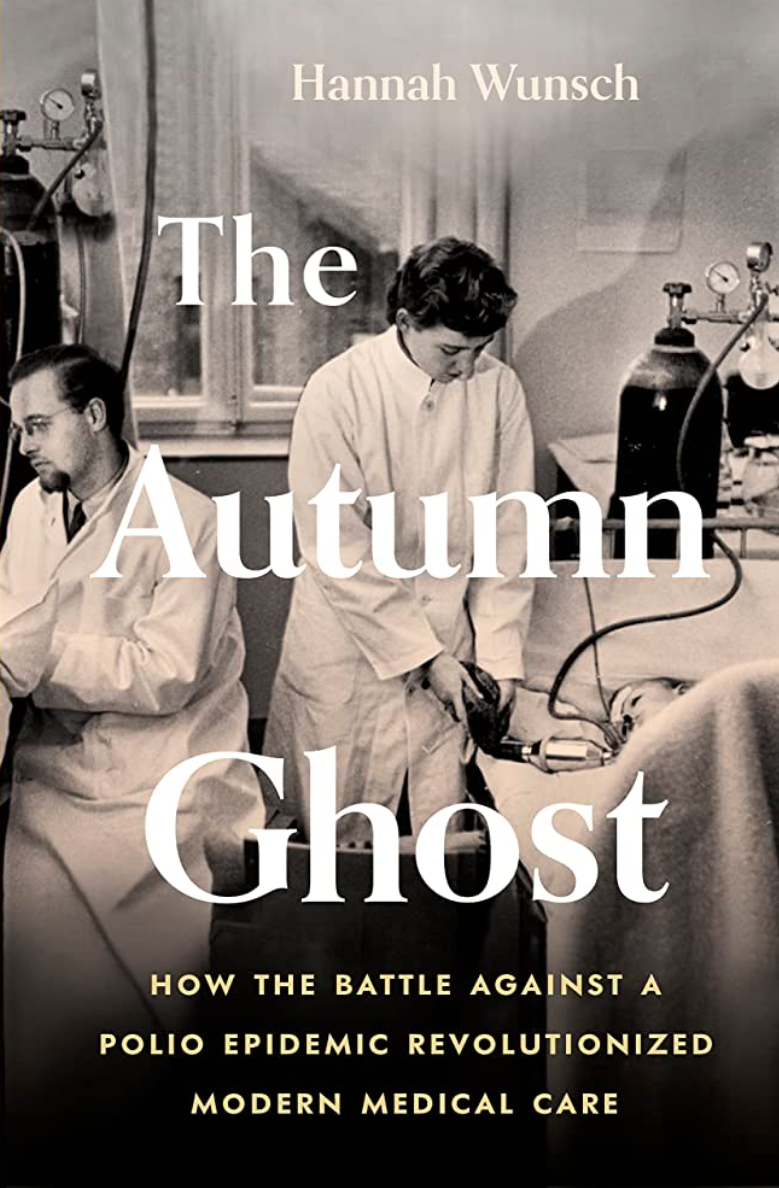
The Autumn Ghost by Hannah Wunsch (Review)

A black and white photo of a female med student standing near a patient's bed, manually pumping a ventilator balloon so a child can breathe. Another student (a man with glasses) sits to the left of her. The title is in white with the subtitle near the bottom in small, yellow text.

Note: I received this in order to review it.

The subtitle of this book (How the Battle Against a Polio Epidemic Revolutionized Modern Medical Care) is incredibly accurate. Did you know the first true ICU was created in Denmark by an anesthesiologist who realized the benefits of such a department because of what he saw during a polio outbreak in 1952? We also have modern blood gas tests due to the necessity of frequent pH checks of polio patients' blood.

The story is structured a bit like a medical mystery. A lot of the focus is on a hospital called the Blegdam, the only contagious disease hospital in Copenhagen. The author even goes through how hospitals in the city helped hide Jewish people and assisted the Danish resistance in World War II; the war shaped alliances between doctors into the 1950s. A good amount of the narrative goes into the deluge of polio cases during the aforementioned summer of 1952. 

I thought this book was going to be dry, but it's actually full of life and many interesting tidbits. Most people introduced (researchers, doctors, and patients) in this book have photos and pieces of their personalities sprinkled in. The reader hears what happened to them after the disease left their lives and what came next, if anything. Not all endings are happy. 

The medical terminology and inventions were presented in a way I understood. It was cool knowing what industries gave the medical field certain innovations or improvements.

Medical experiments on animals were brought up fairly often. If you're the type of person who doesn't want to read how animal testing leads to breakthroughs or setbacks in the medical field, you might need to skip this read. It goes far beyond the typical experimentation on mice. Another thing that might upset readers is the trial vaccine given out at schools/homes for the "feeble-minded" with no guidelines in place (or, at points, consent); but there are only two brief instances mentioned. 

A lot of historical context is given, especially if there was a device or concept floated around well before an equivalent is introduced in the 1940s or 1950s. For instance, the idea behind the iron lung existed way before the ones we currently think of were on the market. 

I learned a lot from this book and don't regret a minute I spent reading it. I even learned the story behind the creation of the boardgame Candy Land. I recommend this book.

Friday, May 19, 2023

Two Poems by Rebecca Upton Hayes

On Life with Pain

The pain snakes through my body
starts in my feet/makes its way
up my spine stops in my shoulders

Others don't understand
They are used to having pain
in one place at a time like
if they stub their toe or bang
their knee against their desk

I hurt for no reason and any reason
and every reason

I take Lyrica hope for salvation
Hope it will eliminate these aches
Free me from this cycle of pain

I make plans anxiously because
how should I know how I will feel later?
And I worry others think I’m flaky when
I cancel like I’m lying about feeling
too achey or exhausted

If I was lying I’d come up with something
more interesting
If I was faking anything
I’d make it all more interesting
than this
~*~
Hashimoto's Disease, 2018

i stare into the blank spaces of walls at hospitals
i ignore the flowers
this place feels too bleak for such beauty

i could count how many times i’ve been here this year
if i checked my records on the account the hospital gave me
but i’m afraid to find out

in the MRI waiting room we’re all there
for the same thing,
so doctors can take pictures of our brains
and tell us if we’re normal
i didn’t mind having it done
but i wish they picked a different Pandora radio station

the doctors think i’ll be fine if i keep taking my new medications
this could be comforting but it isn’t
i want to feel better now,
i’m sorry if that seems a little unreasonable
okay, i’ll shut up now, i’ll stop asking questions
sorry doctor
yes, i’ll take my pills every day

the pins and needles come back all the time
sometimes i feel heat when i shouldn’t
i want to play guitar i want to do anything
other than massage my own aching joints
i hate that this has become my life now
they promised it would get better than this
nobody tells you what to do when it doesn’t
~*~

Biography: Rebecca Upton Hayes is a writer currently finishing her degree in Disability Studies at CUNY School of Professional Studies. Her creative and academic work are inspired by her experience living with disabilities. You can find pictures of her cat and her creative work on her Instagram at instagram.com/softgothkitten.

Friday, May 12, 2023

Two Poems by Kat Falacienski

Preparation 

(I was once asked what kind
of animal I would want
to turn into, which species
would unsheathe
my self
And everyone else was going hawk
and wolf and lion
And I chose
a honeybee)

(And I imagined
someone asking Why? Bees
don’t live long

And I thought about
how Jacqueline Woodson
once wrote that on paper,
a butterfly never dies
And I’d like to think
she’d extend
the same grace
to me)

At home, I know the insects
only by their sounds.
The high-pitched hum
that sounds more like
a machine
than a living being.
The batlike squeak
and rustle of wings.
The fwt of someone
jumping and gliding
and landing.
The ones in the junipers,
clicking constantly
like invisible rain,
busy in the way
that only
small things
can be.

That
is how I wanna be:
heard but not seen.
~*~
the food network

The lady on the food network has red hair, the color of cinnamon in the evening. It’s just past eight a.m. and my eyelids are gooey as I blink beneath bare fluorescent lights. She is demonstrating how to make food to watch the Super Bowl with, food you can scoop into your mouth without looking, food that is just pleasurable enough to relax your tongue but not so good that you have to close your eyes. 

I had no idea the Super Bowl was even happening.

Two hours later I have not left this building. Instead, I am lying on a chair that is pretending to be a bed, my arms and legs scrunched up tight, staring at a tame blue wall through the threads of a blanket. I couldn’t breathe before. I felt like I was falling, the air yanked from my lungs so fast they nearly turned inside out. Now, the tips of my toes have touched something solid; now, the contents of my chest have settled. But I’m impatient: I mean I haven’t been down here that long, right? I wanna claw my way back up. I haven’t missed much, right? I wanna rewind, go back in time. Back before all of this happened. Back when my hair still shone cinnamon red in the soft evening sunlight. Back when I thought that things like this only happened to other people. 

I think I’ve hit rock bottom.

But then, I remember the lady on the food network, remember the way she slit open a plastic bag of Chips Ahoy cookies, plopped several flavors of ice cream into the bag, and drowned the whole thing in sickly syrup. Then she gets a spoon and just starts eating right out of the bag. Look, she says, a portable sundae. In the blue room I close my eyes and finally feel a little lighter. Not because I’ve seen the light or whatever, but because I suspect that behind that TV smile, behind the shimmering hair and the symmetrical face, the lady on the food network with her gooey go-girl sundae is most definitely tasting the bitterness of her own lipstick. 
~*~
Biography: Kat Falacienski is a student at Colorado College. She has been published in Teens Resist, Affinity Magazine, the Catalyst, Cipher Magazine, Leviathan Magazine, and YOGURT Culture Zine. She has also been featured in Quincy Hansen's book Shake It Up! How to Be Young, Autistic, and Make an Impact.

Friday, May 5, 2023

Book Review: These Gossamer Strings by Allegra Pescatore

A blond, white woman sits on the grass by a river in a faded denim-colored robe. The sky is dark with reddish clouds. A small, white dragon sits behind the woman facing to the left with its tail curved into the water.
Note:
I received a copy of this book for free.
There will be minor spoilers of the series (including this book).

Elenor has less than three weeks left before she faces a tribunal for her father's murder and must complete the rite that ensures she stay on her throne. As if Elenor didn't have enough to deal with, her mother is still missing, her diabolical aunt threatens the life of someone she loves, one of her best friends wants to kill her, and she's going through a flare.

Her allies have secrets and loyalties soon to be revealed:
Gabe's heritage might save the continent or damn it.
Daemon's wicked past comes back around.
Fedrik might be Elenor's savior or executioner.
Her mother both loves and hates her.

All the pieces are in play for the final installment of the first arc of the
Last Gift series.

There is a fair amount of action in this book: Chase sequences, battles of magic, explosions, and hand-to-hand combat all occur. Everything is described with enough skill so I knew what was happening without the passages being repetitive. There is torture in this book but far less than the novel where Gabe was kept in the dungeon.

Everyone's motivations (whether complex or simple) are fully presented as they act. Those of moral ambiguity (like Dae) are given the leeway to inhabit or change who they are. I can see even the minor characters as full people in my head, and it's not just because they are described as physically diverse. I will say I wasn't thrilled with the outcome of two characters: Prince Cassian and North because I felt like, though their motives made sense, they left me with a sense of wrongness.

All the various settings are still gorgeously described without bogging anything down.

One of the gripes I had with the first book was not knowing much about the motivations of the main villain. But this book puts so much in perspective as we get to know Elenor's mother; she has so many secrets connecting the dots on Elenor's father that it felt like we finally got a real look at what drove him. I still hated him at the end (and his wife somewhat, too) but still.

The book goes at a good pace while leaving room for character development and surprises. Every chapter felt necessary. 

Elenor and Gabe have more than one discussion about the use of her painkiller. As her physician, he often tries to warn her away from a higher dosage because of the potential risks. She argues that she's taken the drug for over thirteen years and knows her body's limits. I thought this debate (one chronic pain patients have all the time) was an excellent inclusion. To his credit, Gabe never accuses her of being an addict or threatens to take her meds away.

There are large threads of hope, perseverance, found family, and redemption even during the darker parts of this series which I appreciate... especially since some sections can get quite grim.

If you're expecting a neat bow on the ending, you'll be disappointed. While some of the threats are gone by the epilogue, some manage to escape and others appear at the end. This series is definitely far from over. But I loved it, recommend it, and can't wait for the next arc!

Friday, April 14, 2023

Chemically Unbalanced by Gary Bloom

There is a chemistry experiment
Going on in my head.
The synapses are not firing
Serotonin is sinking.

I am popping Prozac
Like it’s from a Pez dispenser.
Norepinephrine is depleting
The pendulum is swinging
Toward mania.

My shrink says
It’s chemical warfare
And whips out his prescription pad
Like a weapon.
~*~
Biography:  Gary Bloom grew up in Minneapolis and attended what is now Minnesota State University- Mankato, where he studied sociology. He has been a teaching assistant in a psychiatric hospital, a driving instructor for spinal cord injury patients, and a computer programmer. His articles and poetry have been published in newspapers, magazines, and websites, including Kaleidoscope Magazine, Breath & Shadow, Serotonin, Milwaukee Magazine, The Buffalo News, The Grand Rapids Press,  Art Times Journal, and Black Diaspora. Many of his poems are about depression, which he has suffered from since his late teens.

Friday, March 31, 2023

Life and What Drives Me by Spazzy Crafter

Two knit baby hats are on a transparent table. One is a blush pink and the other is blue with hints of purple.

I was born early one morning in late July in the southern part of Wisconsin. Mirroring my normal enthusiasm for life, I arrived twelve weeks too soon at two pounds and twelve ounces. The doctors didn’t give me a good prognosis; if I survived, I wouldn’t be able to chew gum or even swallow.

I spent the first month in the NICU. One of my parents stayed while the other was home with my older siblings. When I was finally released from the hospital, I weighed just barely over two pounds more than my starting weight. I wore Cabbage Patch doll clothes for the first six weeks of my life.

This year, I enter the period of life people affectionately call the “late thirties”. I survived beyond all obstacles.
~*~
I began loom knitting two years ago and had an idea: I'd donate preemie hats to local hospitals. It's my way of giving back and has helped me find a sense of purpose. It’s a way to keep the little ones warmer and more comfortable while surrounded by the bright lights and invasive tubes.

I have a whole bag of momentos from those early days, though I obviously can’t remember them. Someday, I hope my hats end up in other people’s bags and boxes of memories, and that they can hold them in their hands decades later.

Friday, March 17, 2023

The Price of Prisons for Profit by F.I. Goldhaber

First published on Tiny Tim Literary Review

You ignore millions of people of color incarcerated
for petty crimes -- some innocent -- imprisoned without hope, deprived
of contact with families, proper nutrition, medical aid.

You reject myriad mentally ill patients jailed without their
medications or psychiatric care, treated like animals
by sadistic guards who don't even allow them to know the time.

Left to psychologically rot in jail, often with no pillows
or blankets; bereft of in-person contact by monetary
setups that charge more than they can afford for video visits;

Denied access to life affirming hormones, always misgendered,
abused by both guards and fellow prisoners for daring to ask
for acceptance of identities outside binary genders;

Forced to work for pennies an hour manufacturing garments
furniture, electronics, and more, so corporations that pay
no taxes can claim their merchandise is made in America;

Caged for twenty-three hours a day, prevented from sleeping, hungry,
alone, required to pay hundreds to the governments trampling their
rights and destroying their health; these wretches escape your attention.

Until the trap of private*, pecuniary, prisons captures
someone you love, subjecting them to the tortures others endure
day in and day out across the U.S. from sea to shining sea.

Only then do you complain about corruption, assail abuse,
deride the debasement, impugn inequities and injustice,
and discover organizations that have fought this for decades.

You retain attorneys, pay for visits, purchase comfort from the
commissary. You advocate for reform, write letters to your
legislators, and sign online petitions to the president.

But those who do not have families with resources perish in
prison, expiring from exploitation, strangled by their sorrow,
succumbing to suicide, murdered via medical neglect.

Once the ordeal ends for your own victim of prisons for profit,
will you continue to campaign for those who have no such support?
Or will you forget that your loved one's journey is hardly unique?

Will you return to ignoring the relationships ravaged, the
communities crippled by losing those sucked into schemes designed
to dehumanize those who are minorities, moneyless, mad?
~*~
*Poet's Note: Although this poem refers to a specific individual's situation, the conditions described apply to all prisons (public and private) and many jails in the United States, an $11 billion industry which incarcerates more than 2 million people, many of whom have never been convicted of any crime.
~*~
Biography:  F.I. Goldhaber's words capture people, places, 
and politics with a photographer's eye and a poet's soul.
As a reporter, editor, business writer, and marketing communications consultant, they produced news stories, feature articles, editorial columns, and reviews for newspapers, corporations, governments, and non-profits in five states. Now paper, plastic, electronic, and audio magazines, books, newspapers, calendars, broadsides, and street signs display their poetry, fiction, and essays. Left Fork press published What Color is Your Privilege? -- a collection of political statements in poetic form -- in September. http://www.goldhaber.net/

Thursday, February 23, 2023

Where the Road Ends (Shutting Down HUP)

On a green sunburst background are the letters HUP in dark green. The H has silver pen nibs coming down on each side, and the P has a wheelchair symbol on it with the tire completing the loop.

After May, I'm closing this space. I will keep it as an archive (and will continue the Twitter account). I thought things would improve both in my personal life and HUP in general by now, but our seventh year will be our last.

I'm so grateful to everyone who mentored for the program, trusted me with their work, or helped me run things (definite props to Val). One of the best parts of all the time, money, and spoons I put into this was meeting some amazing folks. You made this ride worthwhile.

Submissions remain open until I get enough content to send everything off in style. I have one book review (apologies for the delay, Allegra) before June.

To those of you who said you could do things better than me: I hope you do. I hope you start amazing shit for our community that rivals any idea I've ever had. I want to see crips skyrocketing to where they want to go because of your efforts. I'm cheering for you.

And I'll still be cheering for every reader, submitter, and creative crip until my voice gives out. Thank you for everything. 

Friday, February 10, 2023

Shot by Cameron Morse

Do I have more in the barrel
the cannon or
could it be my time here

is spent? My left hand is shot
I know that for sure
but I keep firing off footsteps

despite the abnormal gait I keep
patting the back
of an inconsolable baby.

Her cries shrill each cell
of my body
into string beans.

The grind of teeth in the dark
bed beside you
are two rocks rubbing

themselves into particles
of themselves.
Craggy faces smoothed out

featherdusted until featureless.

~*~

Cameron Morse holds an MFA from the University of Kansas City-Missouri and lives in Independence, Missouri, with his wife and three children. He is the author of ten collections of poetry and serves as Senior Reviews editor at Harbor Review and a reader at Small Harbor Publishing. His first collection, Fall Risk, won Glass Lyre Press’s 2018 Best Book Award.   

Friday, January 13, 2023

Two Poems by Jyothsnaphanija

Saccharine

coldness and glitter
Filled solution reaching the throat
Listening when nobody speaks,
We find pleasure in cutting paper into fine uneven
Shapes of
Big and small
cucumber sticks
hair,
slabs.
Infusers.
Fire in us
wilting sleep
frozen speaking, hating clean love.
Even in the depth of a game, we were obvious to trace ourselves.
In our possession,
thesaurus of cracked glitter
handfuls of blur.
We check time in a hurry and leave.
Dizziness as shadow
Chewing us.
~*~
Plain song of snow

Whenever I go to a new city
I listen to a bird.
Then I try to figure the notes,
keys and scales.
Fresh and unstable geographies.
I count till the date of departure
I often get calculation of lines in a sonnet wrong though.
~*~

Biography:
Jyothsnaphanija teaches English Literature at ARSD College (University of Delhi), India. Her first poetry collection Ceramic Evening was out in 2016. Her poems most recently have appeared and are forthcoming in Quail Bell Magazine, Plato’s Caves, Wishbone Words, The Hopper, Bosphorus Review of Books and others. She blogs at phanija.wordpress.com

Friday, December 16, 2022

Two Poems by Mark A. Murphy

Poet's Statement: I have always thought that poetry can change lives, and still do. I believe artists have a responsibility to step up to the mark, and say the things, others, perhaps less privileged, would like to, or are unable to say. If humanity is to survive the current and impending ecological disaster beyond the next generation, we must learn new ways of living together.
~*~
Murphy’s Law

When the money lender closes her door,
displacing any sense of association
or good relations, you wonder
if the old woman will pause long enough
to take any account of the dislocation.
When the proverbial nose
is put out of joint for the last time,
you wonder if the filter tip
burning like a Roman Candle
belongs to the long litany of anything

that can go wrong.
ii
When the father of the bride concludes
she will not buy the book
you spent a lifetime writing, you wonder
if the planet without a visa
really is just another excuse for killing
as the homesteader expands

across the prairie
like stars in a night of passing buffalo.
~*~
Homecoming

What’s sought is no more tangible
than river sounds.
      The shoots of stars.
So, we wait in the dusk, half-blind.
Our destiny temporarily on hold.
As we saw fallen oak and ash.
Hagg Wood trembling
      in hail and snow.
Two brothers driven
by Siberian winds. Collecting logs.
Unaware of the moon. Frozen holly.
Frozen mud.

Unaware of each other. But for love.
~*~
Biography:
Mark A. Murphy has had work published in 18 countries. He is a three-time Pushcart Nominee, and has published eight books of poetry to date. German publisher ‘Moloko Print’ published his latest collection, The Ruin of Eleanor Marx in the summer of 2022.


Friday, November 25, 2022

The Four Responses by Cass Heid (Spoken Word)

Click here to go to the video.

Artist's Statement:

This poem was inspired by the TV show Avatar: The Last Airbender, which I loved when I was younger, but as an adult began to bond with in a completely different way. This past June, as I was preparing something to read for an open mic event at my graduate program, the theme song began to play in my head: "Water, Earth, Fire, Air". 

I had been planning to read a different poem for this event, but began to wonder how these elements would sound in the form of a spoken word piece. More importantly, I wondered how I could make them relevant to the themes that I already loved to write. As someone who also writes creative nonfiction, trauma, mental illness, and especially neurodivergence are important topics for me as I believe that everyone deserves to feel safe discussing them openly.

I began to think of every emotion that I personally experience and compare them to the elements: water as grief, earth as stubbornness, fire as rage, and air as fear. When I had this list running through my head, I realized how much of these emotions come from trauma. I then remembered the four trauma responses: fight, flight, freeze, and fawn. For the next few days, the poem began to form in my head, and play on repeat until I had no choice but to get it out on paper. This ended up being the poem that I would read for the performance, and the reactions to my reading would make me realize that this was the correct decision. 

~*~

Biography: Cassidy is an autistic and ADHD writer whose genres include creative nonfiction, fiction, and poetry; but her most notable work is in the performance art of spoken word. A native of Swoyersville, Pennsylvania, Cassidy will soon earn her Master of Arts in Creative Nonfiction from Wilkes University; where she had also earned her Bachelor of Science in Earth and Environmental Science and a minor in Spanish. She can be found working on her debut essay collection, taking care of her abundance of houseplants, or training in mixed martial arts at her neighborhood dojo. 

Friday, November 18, 2022

Somewhere by Charlotte Bray

CFS crumples you into a ball,
Ready to be thrown away.
But look hard enough
And all those same things
That are written on you, into you
Make up the very essence of you,
Are still in there,
Somewhere.
The things that make you tick,
What makes you laugh,
The moments that make you tingle,
The things you care about,
What matters.
It matters,
You matter.
Those creases and lines
That the illness brings
Are not part of you,
Not really,
They are only the surface,
Not your soul.
~*~
Biography:
Charlotte Bray lives in the UK with her family and 2 rabbits. She has CFS/ME and uses writing as a way to express the challenges of living with this condition. By sharing her writing, she hopes that it will spread understanding and resonate with others who may be living with a chronic illness/disability. She loves audiobooks, trees, herbal tea and her dressing gown! This is her first published piece of work.

Instagram: charlotte.restmakesmestronger
Facebook: charlotte.restmakesmestronger

Friday, October 28, 2022

Interview with F.I. Goldhaber on What Color is Your Privilege? and the Topics of Their New Collection

The outside edges have shades of yellow to red fading into each other with the middle being six photos of various people (man, woman, Black, Muslim, Jewish, etc.) The top of the image has the title in white with the author's name on the bottom.

Handy, Uncapped Pen: What was the most difficult thing about writing this book?

F.I. Goldhaber: I didn't "write" this book. I compiled poems that were written over a period of eight years. That said, the most difficult part of putting it together was figuring out the best order for the poems and that kept changing as I added more poems.

HUP: How long did What Color is Your Privilege? take to write/organize?

Goldhaber: I first started putting the collection together (and came up with the title) five years ago. At that time it included 20 poems. In a year it had almost doubled in size and I began sending it out to publishers for consideration.

About a year after that, John Warner Smith, who would be named Louisiana State Poet Laureate two years later, hit up the email list of contributors to Black Lives Have Always Mattered, A Collection of Essays, Poems, and Personal Narratives Edited by Abiodun Oyewole published by 2Leaf Press (in which he and I both had poems). He sought blurbs for his fifth collection—which eventually became Our Shut Eyes, devoted to racial history and contemporary issues of race in American society—with an offer to reciprocate.

Of Our Shut Eyes I wrote, quoting one of his poems, that Warner "plays the 'old familiar song, an American song of race, hate, and rage' for new audiences."

Warner described What Color is Your Privilege? as "a book-length blues song decrying racial, gender, religious, and sexual intolerance in America."

While I submitted the book, it continued to grow. Each publisher got a slightly different compilation as I added new poems I'd written and sometimes new versions of previously unpublished poems (I don't consider a poem to be in its "final form" until it's published). I even added poems after Left Fork accepted it for publication a year ago, the last two inserted in May of this year, for a final total of 72 poems.

"But, does anyone hear my words? Do
they heed my warnings? They sit and nod,
sometimes buy my books."

-from "Poetry "
HUP: Writers who are activists can often feel like their words are useless when it comes to inspiring change. What would you say to those writers?

Goldhaber: That poem actually started out as my introduction when I read poetry at live events and gradually morphed into the introduction to What Color is Your Privilege?

To answer your question, I would say keep writing. Keep submitting. If you only reach one person, if your words influence only one reader to change how they think/approach the world, consider that a success. (And you never know which poem will touch which reader when.) You never know when (and may never learn about) one person will make a difference, however small, that will impact another (or many others) in positive ways.

What Color is Your Privilege? received 22 explicit rejections and 12 implicit ones before it found its perfect home (i.e. someone who loved the book and was excited to publish it) at a press I'd only known about as the indicia on books by colleagues. (I never saw Left Fork on a list of publishers seeking submissions, it has a very narrow focus, but turned out to be a splendid fit.)

Although every one of the 72 poems had been submitted for consideration to at least one publication, only 56 were published previously and almost all received at least one rejection.

Perseverance is key in publishing and protests.

HUP: You talk about passing as white in "Little Old White Lady". How has passing influenced your activism?

Goldhaber: Passing allows me to observe the behavior of those for whom I intended this book—privileged, liberal, white, abled, cis people—when they're not performing (and I mean that in the literal sense) as allies and to better understand how liberals contribute to the problems of systemic racism, ableism (always a tool of white supremacy), and other forms of oppression. (Liberals are today's white moderates about whom Martin Luther King Jr. warned us in his Letter from Birmingham Jail: "more devoted to 'order' than to justice".)

It also gives me the privilege of using that assumption of whiteness to advocate for, and when appropriate, interfere on the behalf of those who are not as I did in the incident related in that poem.

If the service is free,
you’re not the customers,
your data’s the product.

-from "Products for Sale"

HUP: I think these lines are so important, especially for marginalized folks and activists when so much can be used (not just for marketing) against them in various ways. Do you have any tips for those who have to be "present" online for one reason or another but want to be cautious? Is controlling what you share and not clicking ads enough?

Goldhaber: It's a start. My best advice is to treat everything online with the utmost paranoia (just because you're paranoid doesn't mean they aren't out to get you) and to always give as little information as possible. Every single entity you share personally identifying information (PII) with has a) the potential to be hacked making that information available online for the world to access and b) the ability to share your information with entities that will try to sell you things you don't need at best and seek your destruction at worst. In addition:
  •    Don't share your phone number, DOB (use a fake one if it's required e.g. on Facebook), Tax Identification Number (including your Social Security number), home address, etc. anywhere you don't have to, but especially social media accounts, posts, or "private" messages. Even "security questions" asking you for seemingly innocuous information like your first pet or where you went to school, are data gathering traps. Make stuff up.
  •    Do not take quizzes, sign petitions, or play online info games. Those are at best data gathering tools and at worst PII thefts (notice how often the questions mirror those "security" questions).
  •    Just because someone asks you for information, doesn't mean you're required to provide it (e.g. medical offices and insurance companies ask for your TIN/SSN). Do not give it to them.
  •    Don't use your phone to log into social media or access your financial information, doing so shares that information with Google or Apple (depending on whose OS you use) plus the app you're using and whoever it sells your data to.
  •    Remember, anything you post on social media, including posts/messages marked private or deleted are never private.
  •    Turn off tracking on your phone and use tracking blockers in any browser.
  •    Don't use the same email address for social media that you use for your financial or personal correspondence (IMO, everyone should have at least three email addresses and a free gmail or similar type account should only be the one used for social media).
  •    Don't log into any accounts, as you're often encouraged to do, with Facebook, Google, or any other social media, because that shares your information with those entities and they will use it. Always create a new, separate, unique account.
  •    Use unique, secure passwords (12 or more characters in an incomprehensible combination of letters, numbers, and symbols) for each place you do log into. Invest in a password "safe" to track your passwords (and whatever fake birth date or fake answers to security questions you gave), one that stores its data on your machine not in the cloud, and keep an encrypted copy on a separate storage device.
  •    Don't store your data, especially PII, in the cloud.
  •    There's plenty more, of course. And if you haven't been doing these things, The Smart Girl's Guide to Privacy: Practical Tips for Staying Safe Online by Violet Blue can help you mitigate damage already done.

Hate speech is not free speech when it drowns
out the voices of others; when it’s
used to harass those with darker skin;
when it incites violence, murder.
HUP: I can't tell you how many times I've heard that we have to allow hate speech because it's part of our list of rights and not letting people say what they want is a "slippery slope". What is your response to people who say that?

Goldhaber: I don't tolerate the intolerant.

The First Amendment to the U.S. Constitution only guarantees that "Congress shall make no law … abridging the freedom of speech". It doesn't prevent private entities (such as social media companies) from regulating what people are allowed to publish on their platforms, it doesn't require anyone to listen/read hateful words, and it doesn't guarantee freedom from the consequences of one's words (including being fired, shunned, and/or ostracized for hate speech).

Media awarding objective weight to both sides, equating fascist hate speech with leftist calls for change while ignoring the danger of the former and the validity of the latter; comparing violence, death, and civil rights evisceration by the right to protest vandalism from the left, helped create the mess we're currently in.

Words can kill. Hate speech is used to rile up the right, empowering them to doxx, attack, and murder marginalized people and those who fight back (or deliberately harass them into committing suicide). The list of people killed by online hate speech (including Faux News and other so-called "news" media) grows longer every day. People radicalized by "reporters" and "commentators" who get rich pushing conspiracy theories, projecting pedophilia plots, and lying about who's actually interfering with voting rights, education, and the courts, murder children and adults daily.

HUP: I found your poem "Gender Blending Fashion" to be such a sweet, lovely piece about the permission to express gender in whatever way feels true to someone. Why do you feel people try so hard to "police" other people's fashion choices? 

Goldhaber: Policing other people's fashion is very much a part of binary thinking, and an attempt to impose cultural gender constructs on anyone who eschews them. Men can't wear skirts (unless they're kilts) and women must wear makeup and more "femme" clothing. This, of course, ignores the fact that for a time the height of male fashion included makeup, wigs, frilly clothing, and pointy-toed high heels.

Gender is a cultural construction of beliefs/behaviors assigned to people based on their sex. It varies significantly throughout time, across cultures, and controlled by class considerations.

It's ironic that people who claim to be feminists, a movement partially about throwing off gender-restrictive roles, are so critical about enforcing binary, gender-based restrictions. (Which is why I refuse to allow them to claim they are feminists—they're mostly Nazis/white supremacists since that's where fascism starts—eliminating Queer/Trans folk and strictly enforcing gender roles.)

HUP: If for-profit prisons ended tomorrow, what do you think would change in the "justice" system?

Goldhaber: The entire "justice" system is "for-profit" with the sole purpose of furthering oppression of marginalized people. Look at what's considered criminal and what isn't. For example:
  •    Police-reported "property crime" doesn't include employer wage theft (~$50 billion annually) more than triple all theft "crimes" complied in "crime rate" statistics.
  •    Police-reported "property crime" also doesn't include police civil forfeiture seizures, a large percentage of which are not legal, which steal almost six times as much as all reported burglaries combined.
  •    Police-reported "violent crimes" don't include several million physical and sexual assaults committed by police and jail/prison guards each year.
The Thirteenth Amendment to the U.S. Constitution only partially eliminated slavery and involuntary servitude. Slavery is still legal in this country "as a punishment for crime whereof the party shall have been duly convicted". Of course, the Constitution doesn't define those crimes and states in the south quickly passed and still enforce Black codes created specifically to maintain the slave labor force.

Those Black codes have become the basis of our entire so-called "justice system." And, because oppressing and marginalizing people is inextricably intertwined with capitalism, the U.S., with the highest rate of locking up its citizens in the entire world, has an extremely lucrative carceral system. As a result, ending it is fought mercilessly by those who benefit from it. This includes police who make six-figure salaries with all kinds of benefits (health care, time off, generous lifetime pensions after 20 years or less, etc.) and practically unlimited budgets to purchase weapons, vehicles, and other toys bullies like to play with as well as well-staffed public relations departments created to maintain the false narrative that cops improve public safety; District Attorneys who are always better compensated than public defenders; and judges (who often start out as DAs, make exorbitant salaries with large benefit packages, and receive almost no scrutiny about how they operate). All three of these groups often ignore the law they claim to care so much about and/or twist it to serve their own purposes and increase their personal wealth.

The entire punitive cash bail system is a huge profit center as are court fees; fines; contracts to provide meals, health care, clothing, and other services at jails/prisons; monitoring costs (e.g. the person required by a court to wear an ankle bracelet is also required to pay an exorbitant amount of money to "rent" it and billions are spent on cameras and other systems observing the incarcerated); etc.

All of these costs are paid for by taxpayers and the incarcerated at the expense of medical care, food, housing, education, childcare, arts, recreation, improved infrastructure, etc.

Although combined we outnumber our
oppressors, as long as we allow
them to divide and conquer we will
never succeed in breaking our chains
HUP: What do you think is the most effective tool they use to keep us divided?

Goldhaber: Othering. By artificially constructing hierarchies and divisions—whether based on skin color, religion, education, type of employment, gender, immigration status, language spoken, ability, sexuality, etc.—a small number of wealth hoarders pit the rest of us against each other discouraging us from working together to fight their oppression. They project their crimes and grift (grooming/sexual exploitation of children, drug use, theft, government welfare, price gouging, etc.) onto others and create fake issues (abortion, LGBTQ recruiting) to enrage and embolden people who will believe their lies and vote for their sycophants.

Poverty is a policy choice and many acts considered criminal are in fact people trying to stay alive. The cash bail system imprisons poor people who have not been (and may never be) convicted of a crime (often costing them their jobs, homes, custody of their children, etc.) while people with money (if they are arrested at all) are immediately freed.

The federal minimum wage hasn't budged from $7.25 for thirteen years, but the purchasing power of that pittance had gone down almost $3 at the beginning of the year. In that same time period, CEO compensation shot up 54 percent and corporate profits skyrocketed, fueling inflation (but notice inflation is being erroneously blamed on union organizing that has obtained miniscule wage increases) making that already-unlivable wage worth even less.
~*~
Biography: F.I. Goldhaber's words capture people, places, and politics with a photographer's eye and a poet's soul. As a reporter, editor, business writer, and marketing communications consultant, they produced news stories, feature articles, editorial columns, and reviews for newspapers, corporations, governments, and non-profits in five states. Now paper, plastic, electronic, and audio magazines, books, newspapers, calendars, broadsides, and street signs display their poetry, fiction, and essays. http://www.goldhaber.net/

Friday, October 21, 2022

The Beautiful Man: a Portrait by Su Zi

A black man with medium brown skin is slightly off center. He is wearing a half-zip sweatshirt in a brown pattern over a blue shirt with a gold and brown striped tie. He has on a gray hat with brown band. He has a black mustache and goatee. A brick pathway can be seen behind him, as can a gray statue surrounded by hedges in the distance..

A person approaches a public restroom: on the door is a stick figure of a person and a wheelchair—for many people, this is what disability looks like: the wheelchair. There are invisible disabilities, as not all disabilities are immediately perceivable by strangers. Additionally, disabled people learn to hide their vulnerabilities, their differences, their difficulties in an exhausting camouflage known as masking. Ours is a culture that stigmatizes disability.

In the realm of culture and identity, communities of people can create bonds with others who identify as they do; however, sometimes those very cultures will exclude or silence the disabled among them. In an interview with Gavin Christian Brown (August 2022), he readily identified as a teacher, as an actor (film, TV, and theater), as a writer, and as a Black man. Gavin also has health issues, “It’s ridiculously hard to put on my shoes sometimes…hard to shower…to pick things up”. Yet, because he was denied disability by the government, Gavin did not immediately identify as disabled; this conundrum faces many disabled people where states habitually deny aid to half the applicants. Of this situation, Gavin says,” I know I am disabled. I know what my health is like. I know what my abilities are. We have to adjust to do the best we can, despite limitations imposed on us.” In his case, those limitations include “numerous interconnected health issues” that date back decades, and include permanent damage from physical abuse in gym class at age eleven, and for which he recently had surgery.

Gavin is a teacher, and he says that he practices “selflessness as a teacher”. He is also a public persona, appearing in supporting roles on NCIS and in films, as well as being present online. He says he tries to “inspire a lot of people who think they might give up by trying to be positive”. To this end, he posted a picture of his surgical scar, and followers will often find pictures of Gavin next to stars such as LaVar Burton (“meeting him on NCIS was a big highlight of my life. He is the nicest person. At one point, he stopped production to read to the kids and disabled folk at the center where we were filming. I grew up on Reading Rainbow, so I was a bit star struck”). He believes that we can “inspire each other to do better” and often posts philosophical musings for that purpose.

Although Gavin grew up with “multiple head injuries from abuse”, and “collapsed playing Basketball…November 1994” because of an enlarged heart, the medical care was seen as primitive, and his parents “vetoed” medical treatment because of “skepticism”. In the Black community in which he was raised:

Black disability is a closed, restricted space. For some people, disability doesn’t exist, it’s the realm of religion and prayer. There’s no discussion of going for help with mental health, going to the doctor.
There’s a target on your back.
You have to be tough, and you cannot express yourself, or express your pain. It’s seen as weak.
You cannot ask for help. Support networks are kept to intimate circles, plus there’s the feeling of being conditioned to not need them.
And thus, regarding his identity as a disabled person, “it’s such a rare thing for us to be open about this”

For those who only know Gavin as a writer, it is fair—if an identity must be restricted—to see him for this alone: “Writing keeps me alive…it’s wonderful and beautiful…it’s a joy…I love it so much. It’s a tragedy turned into a triumph”. To his credit, Gavin has written a series of books that he says he is happy “if one person reads” and which are available through Amazon.

And while he repeatedly maintains that “men are socialized to ignore pain”, his post of his surgical scar had some “upsetting and racist” responses, creating yet another situation that he finds “very complex and very difficult”. Yet it is our culture which is shallow and restrictive: a government that deliberately undercounts and underserves a vulnerable but significant population; a section of our own citizenry so marginalized as to disavow the vulnerabilities in the community, to veil people in silence; a teacher financially beleaguered enough to work another job; an artist who must fight publicly unacknowledged restrictions and personal physical pain to release work that is sometimes unnoticed. This is far more than the depiction of a stick figure wheelchair would have the mostly oblivious believe. Yes, disabled people are more than the disability seen from afar. In the case of Gavin Brown, yes, he is disabled, and more importantly, yes, he is a truly beautiful man.

~*~


Biography:
Su Zi is a poet/writer and artist/printmaker and edits, designs and constructs the eco-feminist poetry chapbook series Red Mare.

Publications include poetry, essays, stories and reviews that date back to pre-cyber publishing, including when Exquisite Corpse was a vertical print publication, and a few editions of New American Writing. More recent publications include Red Fez, Alien Buddha, and Thrice. A resident of the Ocala National Forest, with a dedicated commitment to providing a safe feeding respite for wild birds, and for a haphazard gardening practice that serves as a life model for all aspects of her work.

Friday, October 14, 2022

Scattered Pain and Nightflare by Lea Ervin

Artist's Statement:  My name is Lea Ervin and I am a 40 year old woman with ADHD, dyslexia, OCD, and stage 4 endometriosis.  I have had learning and physical challenges my entire life, and a year ago, I started painting to explore the body and what it means to live with chronic pain and mental illness.  The three paintings are part of my “Scattered Pain” series in which I depict what is happening inside my body on the outside to give a visual representation of the symbiosis of chronic pain, ADHD, and OCD.  The pelvic regions of each figure have a touch of red to depict the pain and inflammation one experiences with endometriosis along with the scattered colors that represent a neurodivergent brain. It is difficult to express in words the experience of living in this body, so it was necessary to create a visual representation of life with multiple disabilities. These illustrations depict the pain, messiness, and beauty that come with being different and that there is beauty everywhere.  

There are three paintings of a nude woman in a line drawing (from chin to thighs) where she has different colors in her body. The first is called "A Good Day" where the curves of the body are deep blue and there are splotches of light blue and yellow around the form. There is a dark red line slashed across the body just above the vagina like an angry scar. The second piece is "Brain on Fire" which has black lines for the body, and red/orange/yellow all the way across the image... even outside of the body. The color gets heavier towards the right of the image. The last is "Agony" in which the body's lines are red. Red and pink permeate the body. Yellow dapples around the shoulders. A blue streak is seen off to the right, as though it is peace not found inside.

~*~

Nightflare.

My endometriosis pain swirls, saturates, and swims through my pelvis. It coaxes my heart to beat faster pushing the sweat from my pores. My bowels somersault shifting the bile in my stomach into my throat. The pain crushes my bones.

Feeling well is bait, you see.

An unattainable truth that the pain might stop.

But like a crimson demonic chorus, the endometriosis lesions in my belly snarl.

“Remember girl, you will die. But not tonight girl, oh no no no. You’ll just wish you were dead.”

I am a woman undeserving of peace because tonight, by body says otherwise.

The space has long been empty—nearly a decade since endometriosis took my uterus. However, the spawns thrive, bleed, rip, scar and propagate nights of agony, sleeplessness, and hopelessness.

I writhe in the blanket and wring my hands in the sheets.

Fetal position

Straight like an arrow.

On my back.

Hailing Mary with a whisper as to not wake my sleeping husband, resting peacefully next to me.

Oh, to have that sense of safety and comfort.

But I can only count the clock ticks.

Re-check the instructions on the orange pill bottle lying sideways on my nightstand with the cap partially undone.

Tally the hours on my fingers to determine the soonest I can safely take another, and hope there will be rest.

~*~


Biography:
 Lea Ervin is a writer and artist in Alabama. She is a writing instructor at the University of Alabama Birmingham and holds a Masters of Arts in Professional and Technical Writing from the University of Arkansas Little Rock. She has taught on both the community college and university level. As a freelance writer, her work centers around endometriosis advocacy and has been featured in The Blossom (Endometriosis Foundation of America), al.com, Reckon South, The Mighty, and Thought Catalog.  Lea also paints to depict the struggle of mental illness and chronic pain and the parts of both that are hard to put into words. When she is not writing, teaching, or painting, she is collecting vinyl records, bingeing her favorite series, reading, cooking, and dancing around her house to indie rock or jazz. She resides in Oneonta, Alabama, with her husband Brad White and their Beagle-mix, Starla Belle.

Friday, October 7, 2022

Horror of the Hoarfrost Fray by Daniel Moreschi

When bloomy bells and balmy days forsake
A sphere of solstice worn, miasmal skies
Enfold a leaden shroud of winter wake,
A falling crystalline array belies.

The oaks are weaned from reach of red and gold
And held by stranded lines of bleary wings,
With sculptured trunk for base of bastions, holed,
To brave the brink that famished lustre brings.

From fleeting streaks of gleam, to chartless height
Of icy dunes, now flanked by sleety sheets.
Yet swallowed beds patrolled by frost and flight
Become graves when homing light depletes.

For daunting dawns, in lieu of morning song,
Are tempered trills of fretful flits that leads
To lurid storms, with swooping strikes along
A shattered fray on view of scanty seeds.

The roots are rattled by a wild cascade
As turning tails are tolls from layers thinned,
While clouds are sated by the tainted glade
And dusky tinge, when lesions stain the wind.

Though sunlit lances lift the sullen screen
To galvanise the depths of faded earth
And breach the unthawed walls for vital green,
There are no quills to greet the spring's rebirth.
~*~
Biography:  Daniel is a poet from Neath, South Wales, UK. After life was turned upside down by contacting M.E., he rediscovered his passion for poetry that had been dormant since his teenage years. Writing has served as a distraction from his daily struggles ever since. Daniel has been acclaimed by various poetry competitions, including The Oliver Goldsmith Literature Festival, the Westmoreland Arts & Heritage Festival, the Jurica-Suchy Nature Museum's Nature Poetry Contest, and the Hugo Dock Snow Maze Poetry Contest. Daniel has also had poetry published by The Society of Classical Poets and The Black Cat Poetry Press.

Friday, September 30, 2022

Overview: Stamped Cross-Stitch by Spazzy Crafter

Two images: the one on the left is on white with a khaki pattern of two dogs in an autumn basket with leaves. The picture on the right side is of the design fully finished, complete with texture on the chocolate labs.

Everything that comes in a stamped cross-stitch kit:

Embroidery floss

Printed instructions

Needle

Fabric (with the design)

Colored picture of the completed design

The basics and tips:

The easiest way to begin your project is to start from the middle and work your way out. The instructions tell you how many strands of each color you need for each part of the project. Basically, you embroider a bunch of small X’s on the fabric. The most efficient way to not lose your place on your project is to mark off on your instructions. You have to be careful not to get the fabric wet or dirty because it will fade the design. However, dampening your floss a bit on the end helps with threading the needle.

On embroidery hoops:

Depending on the size of the project, you might want an embroidery hoop. Hoops make it easier by allowing you to focus on small areas at a time. I also use them because they are better to hold onto than trying to work with everything laid out. Embroidery hoops don't always come with the kit, but you can find them at crafting stores or Amazon.

To use the embroidery hoop, unscrew the top of the hoop. Put the smaller hoop on the underneath side of the project. Then, put the bigger part of the hoop over the front. Snap the smaller and bigger parts together and tighten the top.

As a disabled crafter:

I need help with inserting the embroidery floss in the eye of the needle and separating the floss strands. My hands just don’t cooperate enough.

Friday, September 23, 2022

Two Poems by Allison Whittenberg

Temperate

my dry wit
held its own
as the rain came down
in spits
then a geyser
we kept talking and talking at the outside table
al fresco -- all wet, oh
still
your zingers
priceless
in the dampness
left us
talking about every little
everything
every
thing.
~*~
The Hard Way

You never know people
till they die
you gingerly page
through their privacy

Those fresh, fateful photos:
mothers in mauve miniskirts,
fathers frying hash browns, wearing floppy hats

After there is nothing at stake,
you find out all that you could have given

A little air comes in,
combats the forming mold that corrupted keepsakes,
contaminated these attic memories

This knowing threatens to sun the was
the is, now, will be more forgiving
~*~

Biography:
  Allison Whittenberg is a poet, playwright and fiction writer. Her lastest collection of short stories Carnival of Reality came out April 2022.

Instagram: therealallisonwhittenberg
Twitter: @allisonwhitten6